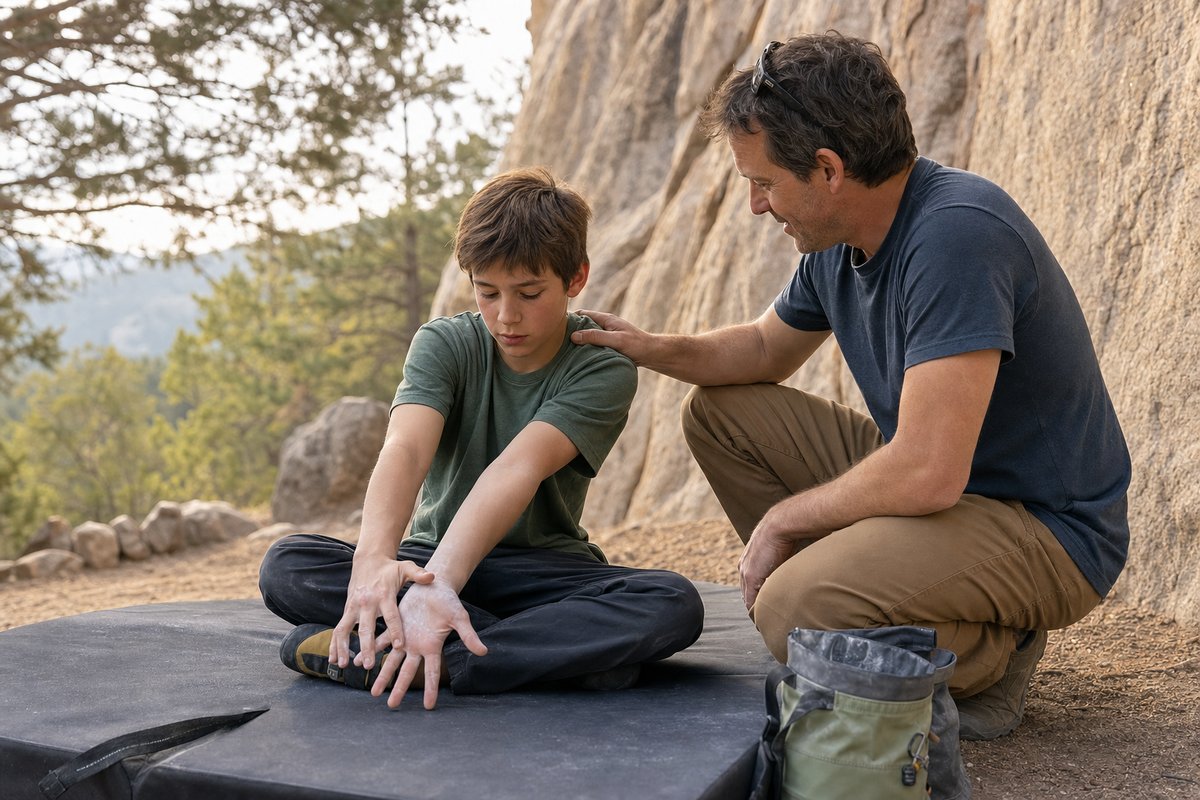
Your kid shakes out the same hand between every attempt. In the car they rub the base of a middle finger and say it is "just pumped." The coach did not see it. You almost missed it too. Then they start dropping off problems they usually fight for, and the ache is still there on the rest day.
That is the moment this page exists for. Not to diagnose a finger. Not to hand you a rehab protocol. To help a climbing parent notice a youth-specific risk, slow the week down, and get a real clinician in the loop before a quiet ache becomes a season off.
This is not a second copy of our broader climbing injuries and prevention guide, and it is not the finger-training or hangboard decision. Those pages stay on their topics. This one stays on growth plates: what they are, why climbing loads them, what parents can watch for, and when to talk with a clinician.
Key Takeaways
- In a 2025 prospective clinic series in BMJ Open Sport & Exercise Medicine, primary periphyseal stress injuries of the fingers were 45.3% of 137 climbing-related injuries in 95 adolescent patients.
- At the 2017 USA Climbing Youth Nationals, Meyers, Howell, and Provance surveyed 267 climbers ages 8 to 18. Only 15% named a finger growth-plate injury as the most common youth climbing injury. Most pointed to the adult-style A2 pulley instead.
- This page is parent education, not a diagnosis and not a treatment plan. Joint pain, swelling, or pain that returns after rest is a reason to stop hard climbing and talk with a sports-medicine clinician.
- Campus boards, hangboards, and closed crimps concentrate load. Our safety guide and hangboard post already treat those as high-caution tools for growing fingers.
- The Belay newsletter is the only current digital product on this site. A printable growth-plate parent card is a proposed future download. It does not exist today, and there is no app or injury checker to buy.
What is a growth plate, in parent language?
A growth plate is a band of developing cartilage near the end of a long bone. It is how the bone gets longer. Until it hardens, it is weaker than the bone next to it. Our safety guide uses that same picture: plates stay cartilage longer than parents expect, often into the late teens.
Climbing does not invent a new anatomy. It applies a very specific stress. A closed crimp on a small edge loads the finger joints in a way playground bars and most ball sports do not. When that stress repeats through a growth spurt, the plate can become a stress injury. Climbing-medicine papers often call the finger version a primary periphyseal stress injury, or PPSI.
You do not need that acronym to parent well. You need to know that "my finger feels weird near the joint" is not the same story as an adult pulley pop, and that kids hide it because they do not want to miss practice.
Why do so many youth climbing injuries land here?
Adult climbing clinics see a lot of pulleys and shoulders. Youth clinics see a different mix. The 2025 BMJ Open SEM series by Schoffl and colleagues recorded 137 climbing-related injuries in 95 adolescents. Almost half were PPSIs of the fingers. The authors also noted that boys waited longer than girls to see a doctor, and that most of those finger injuries developed through repetitive stress, not one dramatic fall.
That last point is the parent one. The injury often does not look like an accident. It looks like a kid who keeps showing up, keeps crimping, and keeps saying it is fine.
A 2020 survey at Youth Nationals helps explain why families miss it. Meyers and colleagues found that 36% of athletes thought the A2 pulley was the most common youth injury. Only 15% named the growth plate. The paper's conclusion is blunt: misperceptions about skeletally immature climbing injuries are common among the kids themselves. Parents who only know adult Instagram injuries will miss the youth pattern too.
What can a parent actually watch for?
Kids are bad historians. They will call joint pain "pump" because pump is allowed. Watch behavior more than vocabulary.
- One finger, same joint. A deep ache at the base or middle joint of a middle or ring finger, especially after crimpy days.
- The shake-out that never switches sides. They keep flicking or protecting the same hand between attempts.
- Grip changes they cannot explain. Sudden love of open-hand slopers on a wall they used to crimp.
- Pain that fades on rest days and returns on the first hard session. That overuse pattern is called out on our safety page and in AAP overuse guidance.
- Swelling, stiffness in the morning, or pain during homework and gaming, not only on the wall.
- A kid who used to beg for one more attempt and now wants to leave early.
None of those prove a growth-plate injury. Three of them in the same two weeks is enough to stop guessing and book a visit.
What should you do this week, before anyone "confirms" anything?
You are not the clinician. You are the adult who can change the calendar.
- Take hard crimps, campus moves, and any hangboard work off the menu until someone qualified looks at the finger.
- Tell the coach what you saw, in boring detail: which finger, how many days, what still hurts at school.
- Call a pediatrician or sports-medicine clinician. Ask whether they see youth climbers or gymnasts. Bring the history. Ask what imaging, if any, they want.
- Do not start a home taping plan, a YouTube "finger protocol," or extra antagonist circuits as a substitute for that visit.
Joel Brenner and Drew Watson, writing for the AAP on HealthyChildren.org, tell families that some discomfort is part of sport, and that consistently ignoring the body's signals can lead to more serious injury. That is the frame. Not "walk it off." Not "season-ending panic." A real exam.
How do training choices change the load?
This post will not publish a hang protocol or a campus age that you can print and argue with a coach. Other pages already hold those decisions:
- Building Finger Strength Safely in Young Climbers covers open-hand climbing, volume, and why feet unload fingers.
- Are Hangboards Safe for Young Climbers? covers isometric isolation.
- The training guide keeps high-intensity finger tools away from most kids and flags ages 12 to 14 as a high-watch window for growth plates.
Meyers and colleagues also found that only 5.7% of those Youth Nationals athletes named 18 or older as a commonly cited safe age to start double-dyno campus boarding. The rest guessed younger, said age did not matter, or did not know. If your gym has a campus board in a hallway with no coach, treat that as a growth-plate risk, not a shortcut.
Better feet and easier terrain are not "giving up." They are how you keep a growing hand in the sport. Footwork Drills Every Young Climber Should Know is about that skill. It is not a medical treatment.
The long view
Most climbing parents will never need a growth-plate diagnosis. The ones who do usually say the same sentence later: we waited because it did not look dramatic. Dramatic is the wrong filter. Repeated joint pain in a growing finger is the filter.
Keep the sport long. Treat a sore finger joint as a clinical question. Use this page to notice and to ask better questions. Use a clinician to answer them. And if you want a short parent note in your inbox rather than a stack of tabs, The Belay is the newsletter. That is the product that exists. A downloadable growth-plate card would be a later, clearly labeled extra, not something you can grab today.
Sources
- Schoffl et al., "Prospective analysis of injury demographics, distribution, severity and risk factors in adolescent climbers," BMJ Open Sport & Exercise Medicine, 2025
- Meyers, Howell, and Provance, "Are Adolescent Climbers Aware of the Most Common Youth Climbing Injury and Safe Training Practices?" Int. J. Environ. Res. Public Health, 2020
- Brenner and Watson, "Preventing Overuse Injuries in Young Athletes," HealthyChildren.org / AAP
- YouthClimbing.com, Climbing Safety for Kids (growth-plate section)
- YouthClimbing.com, Climbing Injuries and Prevention
Frequently Asked Questions
What is a growth plate injury in a young climber?
A growth plate is developing cartilage at the end of a bone. In youth climbers, repeated load on small finger holds can stress the plates in the fingers. Sports-medicine papers call the common finger version a primary periphyseal stress injury. This site cannot diagnose that. A clinician who understands climbing should.
How can a parent tell finger pain from a growth plate problem?
You cannot tell from the couch. Kids often describe a deep ache near a finger joint, not a dramatic pop. Pain that returns on the wall after rest, swelling, or pain that lasts more than a couple of weeks is a reason to stop hard climbing and talk with a sports-medicine clinician. Do not treat this page as a diagnosis.
Should my child keep climbing on a sore finger?
If a specific finger joint hurts during or after climbing, take them off hard crimps and campus-style work and call a clinician who treats youth athletes. Playing through joint pain is not toughness. The AAP tells families that consistently ignoring the body's signals can lead to more serious injury.
Do hangboards and campus boards raise growth plate risk?
Those tools isolate or explode load through the fingers. Our hangboard post and training guide treat them as coach-only decisions, and usually later than parents expect. Meyers and colleagues found that few youth nationals athletes knew a commonly cited safe age to start double-dyno campus work. Wait, then ask a coach and a clinician.
Is this medical advice?
No. This is parent education. It explains what clinicians and climbing-medicine papers report, and what questions to bring to a visit. It does not diagnose, treat, or clear anyone to climb. If you are worried about a finger, wrist, or growth-spurt pain, talk with a clinician.
Where should we go if we suspect a growth plate injury?
Start with your pediatrician or a sports-medicine clinician, ideally one who sees climbers or gymnasts. Ask about imaging if they recommend it. Bring a short history: which finger, when it started, weekly climbing days, and whether hangboard or campus work is in the plan. Our injury-prevention post has more on finding a climbing-aware PT.