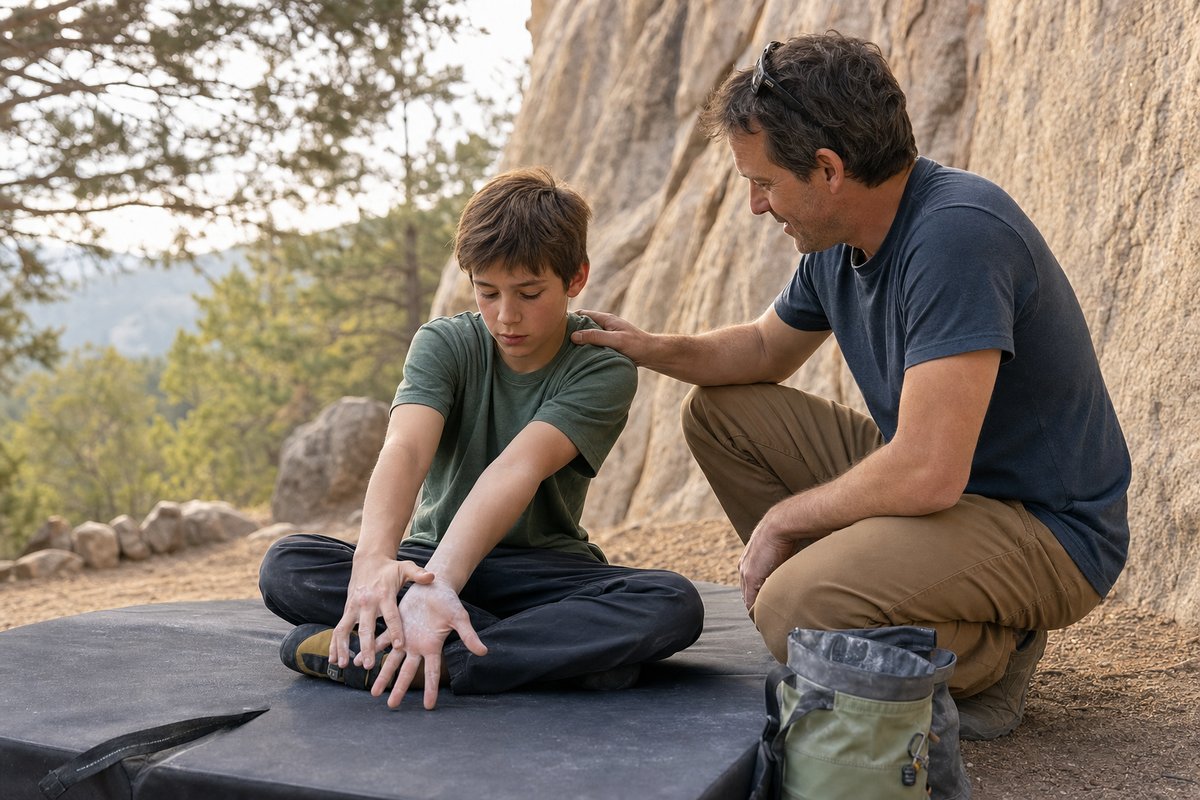
The hangboard is usually on a wall nobody decorated. Small wooden edges. A few pockets. Someone's chalk print on the 20-millimeter rail. Your kid asks if they can try it "just for a second" while you tie your own shoes. A teammate's parent mentions that their 13-year-old has one in the doorway at home. The question lands the same way every time: is that safe, or is that how fingers get hurt?
This post is about hangboards and other isolated isometric finger training, not a second copy of our finger-strength restrictions. For grip positions, campus boards, and the broader "how do fingers get stronger" question, stay with Building Finger Strength Safely in Young Climbers. For age-banded bodyweight work, use Strength Training by Age for Young Climbers. The principles sit on our training and safety guides. What follows is the parent decision: what a hangboard actually does, why coaches disagree on the birthday, and what to ask before anyone starts the clock.
Key Takeaways
- A hangboard trains fingers by holding still. That isometric, isolated load is different from climbing, where feet, hips, and changing grips share the work.
- Growing fingers have growth plates that stay cartilage longer than the nearby bone. Isolated edge loading is the kind of stress those plates do not handle as well as varied climbing.
- This site's parent line is conservative: high-intensity finger tools are not a home project for kids, and they are not a way to "catch up" to an older teammate.
- Coaches do not all use the same start-year. The useful question is not "what age did someone on the internet start." It is whether a named coach is programming open-hand hangs, with no extra weight, on a week that already has rest.
- This is education for parents, not medical advice and not a training protocol. Joint pain ends the experiment. A sports-medicine clinician who understands climbing is the right next call if pain shows up.
What a hangboard is actually asking the body to do
Regular climbing is messy in a helpful way. A kid smears a foot, opens a hand, bumps a hold, and the load moves. Even a steep boulder shares work across the whole chain. A hangboard removes most of that sharing. The athlete hangs from chosen edges and tries not to move. Time under tension becomes the session.
Adult climbers use that isolation on purpose. They already have years of tissue history and, in most cases, fused growth plates. Youth climbers do not. The safety guide explains the basic anatomy in parent language: growth plates are developing cartilage at the ends of bones, and they stay weaker than the bone around them until they close in the late teens. Climbing can still stress those plates, especially with a tight crimp. A hangboard makes a similar stress more concentrated and more repeatable.
That is the distinction this post exists to hold. The finger-strength article covers how climbing itself should load fingers (open hands, volume on moderate terrain, better feet). This article covers the tool that tries to skip the rest of the body. Those are related. They are not the same question.
Why you hear 14, 16, and "when they stop growing"
Walk two gyms and you will get two birthday rules. Our training guide holds both ends of that tension on purpose. The golden rules tell parents to keep high-intensity finger tools away from kids under 16. The age-band section allows that some experienced coaches introduce cautious, open-hand, no-added-weight hangs at the older edge of 14. Eric Horst's youth-strength writing is more permissive still for small, coached doses in the mid-teens, and stricter on campus-style power.
That spread is not a loophole. It is a reminder that age is a blunt instrument. Two 14-year-olds can have very different growth-plate timelines, training ages, and impulse control around a board in an empty gym. Pediatric resistance-training guidance from the AAP is about supervised, technique-first loading of large movements. It is not a green light for unsupervised isometric finger protocols.
So this site will not invent a new official age, and it will not publish a hang protocol for you to print. The parent-safe version is:
- Under the mid-teens: no hangboard. Climbing, plus the bodyweight work in the age-band post, is the grip training.
- Mid-teens: only if a coach you trust names the grip, the times, the weekly dose, and the pain rule. Open hand. No added weight. No "just a few extra" after practice.
- Later teens: still a coached progression, not a doorway hobby. Growth plates can close late. A late bloomer is not a failed athlete. They are a reason to wait.
Home boards, "just dead hangs," and other ways the plan leaks
The riskiest hangboard is not always the one in a team training room. It is the one at home, where no one is counting weekly load and a competitive kid can add a session after a hard practice because a video said 10 seconds on, 50 off. Dead hangs on a bar are not automatically the same tool, but they become the same problem if the goal is longer and longer finger pain.
Patterns that should make a parent slow the whole thing down:
- The board is the extra day. Team already climbs four times a week. The hangboard becomes night five because it "doesn't count." It counts.
- The grip is a crimp because it feels stronger. A closed crimp on an edge is the position our safety guide already flags as concentrating force on finger growth plates.
- Weight is added to "make it real." A backpack on a 13-year-old is not a progression. It is a shortcut around the reason coaches delay the tool.
- Pain is treated as information to push through. Finger-joint pain, swelling, or pain that fades with rest and returns on the wall is a medical question, not a programming tweak.
If you want something useful to do at home, use the age-band strength post: push-ups, a plank, a bar hang with a full-hand grip for a few seconds, then go play. That is general strength. It is not secret finger training.
Questions to ask before anyone starts the timer
Bring these to the coach. Write the answers down. Vague answers are answers.
- Why this athlete, this year, and not next year?
- Open hand only, or are crimps in the plan?
- How many hangs, how long, how many days, and on which days relative to hard climbing?
- Is any weight added, ever, in the first season of this work?
- What exact pain or swelling stops the block and starts a medical visit?
- Will this happen in front of you, or is this a homework board?
You can say no. A good coach can live with a delayed finger block. A coach who treats a parent's caution as a lack of commitment is giving you information about the program, not about your child's talent. Talking to Your Kid's Climbing Coach is the longer guide for that conversation.
The big picture
Hangboards look like a shortcut because they are small, cheap, and easy to photograph. For a young climber they are usually a way to take the most vulnerable joints in the sport and give them the least varied job. Climbing already trains grip every time a kid pulls onto a wall. The rest of childhood strength work can stay general. The board can wait.
If a trusted coach later opens that door, it should look boring: open hands, short hangs, no extra weight, and a week that still has empty space. Anything more intense can wait until the athlete is older and the plates have actually finished their job. Until then, the safest hangboard is the one that stays unused while your kid gets better at feet, tension, and coming back next season.
Sources
- YouthClimbing.com, Youth Climbing Training Guide (age bands and finger-tool rules)
- YouthClimbing.com, Climbing Safety for Kids (growth-plate principles and red flags)
- Eric Horst, "Age-Appropriate Strength Training for Youth Climbers," Training for Climbing
- AAP Council on Sports Medicine and Fitness, "Resistance Training for Children and Adolescents," Pediatrics, 2020 (supervision and technique principles; not a hangboard protocol)
- YouthClimbing.com, Building Finger Strength Safely in Young Climbers
Frequently Asked Questions
Are hangboards safe for young climbers?
A hangboard is not a toy and it is not a shortcut. It loads fingers in a sustained isometric hold, which is a different stress than moving on a wall. This site treats high-intensity finger tools as inappropriate for parent-led training in kids. Any later use belongs under an experienced coach, with open hands, no added weight at first, and an immediate stop for joint pain.
How is a hangboard different from regular climbing?
Climbing spreads load across feet, hips, and changing grips. A hangboard asks the fingers to hold still on small edges for time. That isolation is the point for adult finger training, and it is the problem for a growing finger. Varied wall time builds grip as a side effect. A hangboard makes grip the whole session.
What age do coaches start hangboard work?
You will hear different numbers. This site's training guide mentions cautious, coached, open-hand work only at the older edge of the early-teen band, and it also tells parents to keep high-intensity finger tools away from kids under 16. That spread is the honest picture. Ask your coach which rule they use and why. Do not split the difference at home.
Is a pull-up bar hang the same as a hangboard?
No. A bar hang uses a round, full-hand grip and is closer to playground strength. A hangboard uses edges and pockets that concentrate force on smaller joints. A few seconds on a bar can belong in general strength work. Copying a hangboard protocol on a bar still turns the session into a finger test if you chase time or added weight.
Can we put a hangboard in the doorway at home?
Not as a youth training plan. Home boards are where kids add sessions nobody programmed, often after a full team practice. If a coach later assigns specific hangs, they should happen where that coach can see them. A doorway board with no plan is how a rest day disappears.
What should I do if a coach wants my child on the hangboard?
Ask what grip, how long, how many times a week, whether weight is added, and what pain ends the session. If those answers are vague, wait. Bring the questions from this post and from the finger-strength guide. You are allowed to say not yet.