Last winter our team had a kid named Jonas who started shaking out his right hand between attempts on every climb. Just a little flick. His mom noticed it before his coach did. He had not said anything because he did not want to be pulled from the upcoming regional. Six weeks later he was in a finger splint with a partial A2 pulley strain, watching from the bleachers.
That story is not unusual. The injuries that derail young climbers are rarely dramatic. They are slow, quiet, and almost always preceded by signals the kid did not know how to name and the adults around them did not know how to read.
This is not a medical guide. It is a parent guide. The goal is to help you see what is going on under the surface before a small ache becomes the thing that takes your climber out for a season.
The four injuries that show up the most
Pediatric sports medicine clinics that see a lot of climbers tend to report the same handful of issues over and over. Knowing them by name helps you ask better questions.
- Growth plate stress in the fingers. The most serious risk for climbers under 16. The growth plate at the base of the middle finger bone can develop tiny stress fractures from too much hard crimping. It usually feels like a deep ache rather than a sharp pain.
- A2 pulley strain. The pulleys are little bands of tissue that hold the finger tendons close to the bone. Adult climbers worry about pulley ruptures. In kids, partial strains are more common and can heal well with rest.
- Shoulder impingement and rotator cuff irritation. Comes from a lot of overhead reaching combined with weak scapular control. Often shows up as a vague ache that gets worse on overhangs.
- Knee tweaks from heel hooks and drop knees. Less common but worth knowing about, especially as kids get into bouldering and start loading their legs in unusual positions.
A fifth one worth flagging is general wrist pain, which tends to come from too much hangboarding or too much campus board work too young. Both of those tools should not be in the picture for most kids under 14, regardless of how strong they look.
The early warning signs you can actually see
Kids are not great at describing pain. They will downplay it, ignore it, or hide it because they do not want to miss practice. What they cannot hide is behavior. Watch for these.
- Shaking out one hand more than the other between attempts
- Avoiding crimps and switching to open hand grips that they did not used to prefer
- Quietly dropping off a problem near the top instead of fighting for the send
- Pulling on with the body slightly turned to one side, favoring a shoulder
- Asking to stop early, especially if they normally fight to stay
- Complaining about a vague ache that moves around or has no clear cause
- Sleeping with a hand in an odd position or rubbing their fingers in the car on the way home
None of these prove anything on their own. Three of them in the same week is worth a conversation.
What a smart prevention plan looks like
You do not need to turn your kid into a physical therapy project. Most prevention is built into how the climbing happens. Here is the framework many coaches use.
- Warm up for real. Ten to fifteen minutes of light movement, easy traversing, and progressive grip work. Not just stretching. A cold pulley is much easier to strain than a warm one.
- Cap hard climbing volume. For most kids under 14, two to three hard sessions a week with at least one full rest day in between is the ceiling. The body adapts during rest, not during the session.
- Avoid maximal finger strength training too young. No hangboard, no campus board, no weighted pull-ups for kids who are still growing. The strength will come. The growth plates only get one chance.
- Build the antagonists. Push-ups, rows, scapular pulls, light external rotation work. Climbers get pulled forward and inward by their sport. The shoulders need the opposite movements to stay healthy.
- Sleep and food. Recovery happens overnight and on the plate. A kid who is climbing four days a week on six hours of sleep and a granola bar is going to break down even with perfect technique.
- Skill before strength. Footwork and route reading reduce the load on the hands. A kid who can climb efficiently puts much less stress on fingers and shoulders than a kid who powers through every move.
- Periodize the year. There should be at least one stretch of four to six weeks each year where climbing volume drops and the kid does something else. Not zero climbing necessarily. Just less.
When to rest, when to see someone
The hardest call for a climbing parent is the difference between normal soreness and an injury that needs a professional. Here is a rough decision framework.
Keep climbing, but lighter:
- General muscle soreness that goes away within 48 hours
- Mild forearm pump that fades after a session
- A tweak that resolves with a day or two off
Take a week off and reassess:
- A specific spot in a finger or shoulder that has hurt for more than three sessions
- Pain that gets worse during a session rather than warming up out
- Any sharp pain that came with a single move and lingers
See a sports medicine doctor or PT who knows climbing:
- Finger pain that lasts more than two weeks
- Any swelling, bruising, or visible deformity
- A pop, click, or snap during a move that hurts afterward
- Pain that wakes the kid up at night
- Anything affecting the growth plates, suspected or confirmed
The most expensive mistake is climbing through a finger injury for another month because a regional is coming up. The cheapest move is two weeks off when the signal first shows up.
Finding a climbing-aware PT
A general orthopedist or PT can absolutely help, but climbing has enough specifics that a clinician familiar with the sport is worth seeking out. A few ways to find one.
- Ask your gym. Coaches and gym managers usually have a short list of providers who have treated their athletes.
- Ask other climbing parents. The grapevine in any local scene knows who returns kids to climbing well.
- Look for sports medicine clinics affiliated with a children's hospital. They tend to understand growth plates and youth-specific concerns.
- Search for PTs who list climbing or rock climbing in their specialties. There are more of them every year.
If you cannot find a climbing-specific provider, a PT who works with gymnasts is the next best thing. The hand and shoulder demands overlap a lot.
What to say to your kid
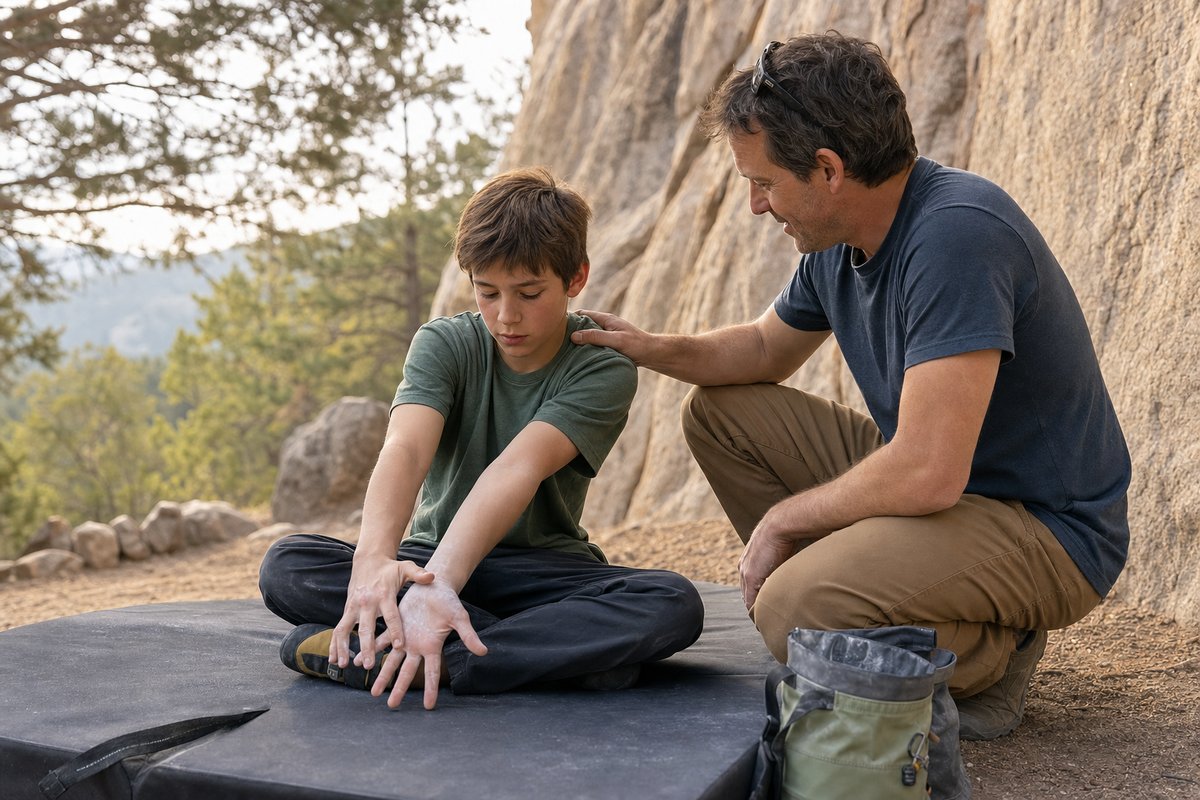
Kids hide injuries because they are afraid of being benched, disappointing their coach, or missing a comp they have been training for. The conversation that prevents this starts way before the first ache.
A few things that tend to help.
- Make it clear that telling you about pain is not the same as being pulled from climbing. Most of the time it leads to a small adjustment, not a season off.
- Tell them stories about strong climbers who took breaks and came back better. There are plenty.
- When they do report something, take it seriously without dramatizing it. Calm interest works better than alarm.
- Praise the act of speaking up, not just the climbing. A kid who learns to listen to their body becomes a climber who lasts.
The long view
Most young climbers who quit the sport do not quit because they got bored. They quit because they got hurt, lost confidence, or burned out. The good news is that all three of those are largely preventable with the same approach. Moderate volume, real rest, antagonist work, and a parent who is paying attention.
Your kid is going to be climbing for decades if they want to. The fingers and shoulders they have at twelve are the ones they take into their thirties and forties. Treat them that way and the sport will give your family a very long ride.