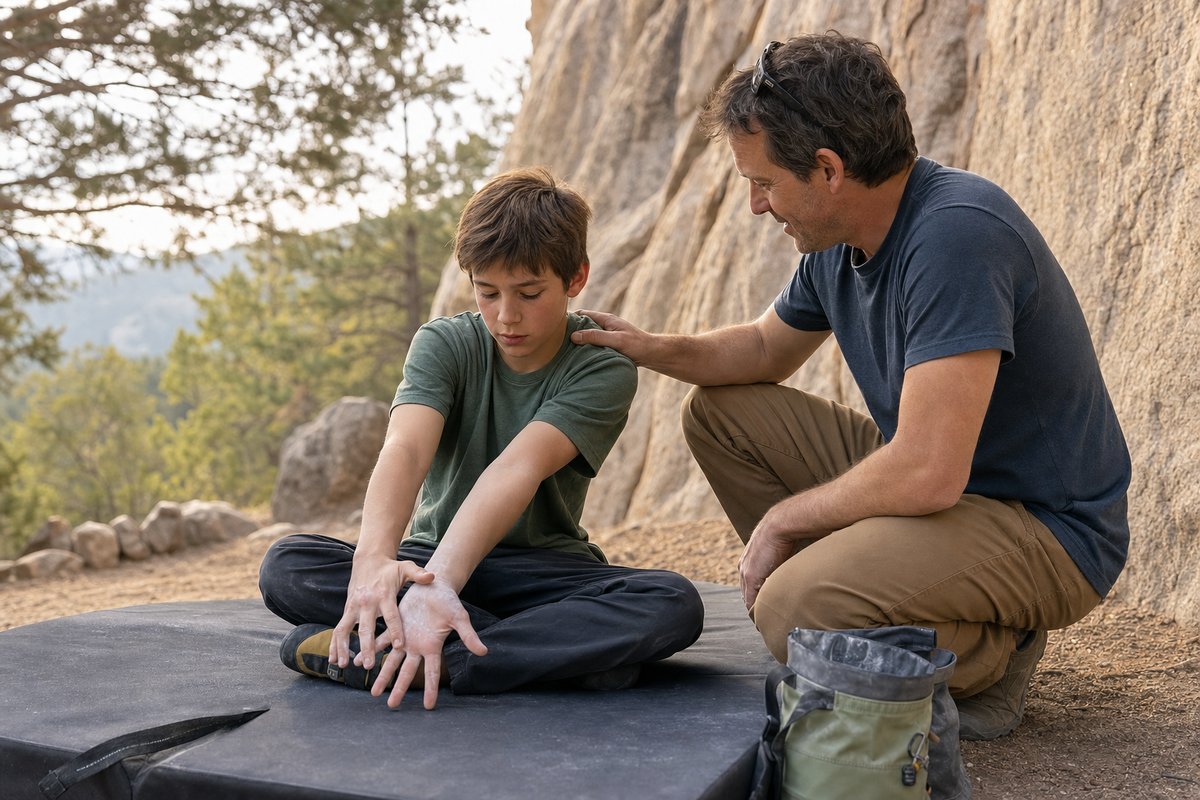
A wrist that still hurts after the session needs a pediatrician or a physical therapist, not another lap on the wall. This page does not diagnose gymnast's wrist or any other injury.
Key takeaways
- Growth plates are cartilage. Pediatric pages say they are injured more easily than mature bone and the ligaments around them.
- Gymnast's wrist is a medical name for overuse at the wrist growth plate in gymnasts. It is not a label you can apply at home.
- Pain that starts only while climbing and later shows up in daily life, or pain with swelling or less motion, needs a visit.
- A home brace, more climbing days, or a hangboard is not treatment.
- An adult climbing podcast is not a pediatric plan.
Why is a growing wrist easy to irritate?
Growth plate injuries: what parents must know explains the finger version. The plate is still cartilage while a child is growing, so repeated load can bother it before it bothers stronger tissue beside it. A wrist can land in the same category when the same mantel or press keeps hitting one spot.
Wellstar Pediatric Orthopedics, in an article published February 27, 2024, describes gymnast's wrist as overuse in young gymnasts from repeated impact in tumbling and vaulting. The injury is irritation of the growth plate at the end of the radius, the forearm bone on the thumb side of the wrist. They write that growth plates are a common injury site in children and adolescents because the cartilage is softer and weaker than mature bone or nearby ligaments.
The article is about gymnasts, not climbers. It says studies have shown that up to 88 percent of young gymnasts complain of wrist pain, and that nearly half report pain lasting more than six months. Those are gymnastics figures, not a climbing-gym count. It also says gymnasts can send up to 16 times body weight through the wrists in tumbling and vaulting. That number is a gymnastics load. It is not the load of a climbing move.
If care is delayed, Wellstar says the radial growth plate can close early, leaving the radius shorter than the ulna, with uneven stress, chronic pain, and stiffness. Found early, they say it often responds without surgery. A long delay often means a long time immobilized, plus physical therapy. Their clinic's window is six weeks to four or five months, with a brace or cast and no impact, depending on severity. That plan starts after an exam. It is not a sleeve from a store.
The American Academy of Pediatrics uses the same name on HealthyChildren.org. Joel S. Brenner, MD, MPH, FAAP, and Drew Watson, MD, MS, FAAP, in a page last updated January 22, 2024, say a gymnast who bends the wrist a lot might get an injury where the wrist bone grows, called gymnast's wrist. They group it with overuse that builds when training outruns recovery. They estimate that 50 percent of sports injuries in kids come from overuse. Climbing is not in that wrist sentence. The pattern to watch is still the same motion, many times, on a growing wrist.
One adult note, kept in its lane. TrainingBeta's November 5, 2025 page with Dr. Tyler Nelson says wrist injuries are the fourth most common problem he sees in climbers at his clinic, after fingers, elbows, and shoulders. That ranking is one adult practice. The episode is about adult rehab. It is not a protocol for a child.
Which signs mean it is time for a visit?
Wellstar says the pain is often an ache on the top of the wrist during impact, starting over weeks or months, often after more training or a new skill. Dr. Steven Schulenborg, quoted there, says it may begin only during the sport and later bother daily life, sometimes with swelling and less motion.
Next to a climbing week, that can look like pain on the top of the wrist during steep moves, mantels, or pressing on a volume, pain still there the next morning, pain while writing or pushing up from the floor, swelling, or a wrist that will not bend like the other one. Any of those is a reason to book, not to add a session.
Brenner and Watson list four stages. Pain in one spot after practice. Pain during practice that does not change performance. Pain that keeps the child out of the sport. Pain at rest. These injuries may not swell or bruise. Some discomfort belongs to sport. Consistently ignoring pain can lead to more serious injury. You do not need pain at rest before you call.
Pain right after a fall onto an outstretched hand is a same-day call, not a slow overuse story. Climbing safety for kids already flags catching a fall with the hands as a common way wrists get hurt.
What should you not do while you wait?
Do not brace the wrist at home and keep climbing. Wellstar's brace or cast comes with an exam and time off impact.
Do not add gym days to warm it out. Overuse injuries in young climbers is the wider pattern: pain that returns in the same spot means change the week and get an exam.
Do not add a hangboard, a campus board, or extra hangs while the wrist hurts. Are hangboards safe for young climbers? is a training decision for a healthy climber. It is not rehab.
Tell the coach which wrist, which move, and whether it hurts at school. A pediatrician or a physical therapist who treats children can sort growth plate, tendon, and a simple strain. If they send you to pediatric orthopedics, go. HealthyChildren.org says its overuse page is not a substitute for a pediatrician. The same limit applies here.
A note for parents, not a diagnosis
The Belay is a free note on first visits, kids' gear, and safety. It will not tell you whether a wrist is injured.
Sources
- Wellstar Pediatric Orthopedics, gymnast's wrist, published February 27, 2024. https://www.wellstar.org/articles/wellstar-pediatric-orthopedics-helps-gymnasts-get-back-in-action-with-gymnasts-wrist-care
- Brenner and Watson, Preventing Overuse Injuries in Young Athletes, HealthyChildren.org, American Academy of Pediatrics, last updated January 22, 2024. https://www.healthychildren.org/English/health-issues/injuries-emergencies/sports-injuries/Pages/Preventing-Overuse-Injuries.aspx
- TrainingBeta, Wrist Injury Rehab with Dr. Tyler Nelson, published November 5, 2025. Adult audience. https://www.trainingbeta.com/media/tyler-nelson-wrist-injuries/
Pages read November 16, 2026. Gymnast figures on the Wellstar page are not climbing rates.
FAQ
Is wrist pain in a young climber the same thing as gymnast's wrist?
You cannot tell from this page. Pediatric pages use gymnast's wrist for growth-plate irritation at the end of the radius in gymnasts. A climber may have that pattern or another one. The name is a reason for an exam, not a home label.
The wrist only hurts on hard boulders. Can we wait?
Wellstar says the pain often starts only during the sport and later shows up in daily life. The AAP calls pain after practice the first stage of overuse. Book the visit while the story is still short.
Should I buy a wrist brace and keep climbing?
Not as a home fix. Wellstar's brace or cast comes with an exam and time away from impact. Ask a pediatrician or a physical therapist before anyone wraps the wrist for the gym.
Can an adult climbing rehab plan cover a child's wrist?
No. The TrainingBeta episode is an adult clinic conversation. It is not a plan for a growing wrist. Call a pediatrician or a physical therapist who treats children.
Who should see the wrist?
Start with a pediatrician or a physical therapist who treats children. They will say if a pediatric sports or orthopedic visit is next. This page is not the exam.