
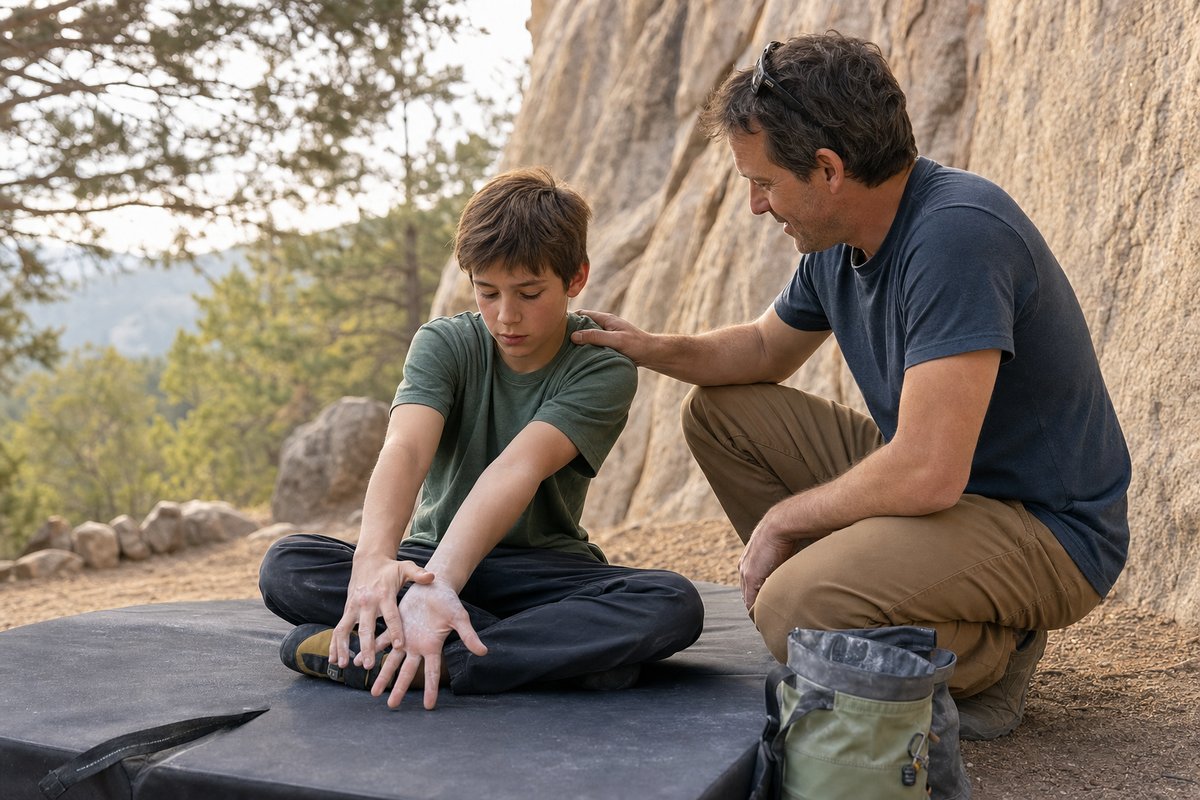
A simple monthly height and weight log shows you when your climber is in a fast growth stretch. That is the window to ease finger-heavy training and keep the climbing they still enjoy.
This is parent bookkeeping. It is not a medical chart, not a diagnosis, and not a clearance to train. A pediatric visit reads growth with its own tools. Pain still needs a clinician who can examine the hand. For what growth-plate injuries look like from a parent's seat, read growth plate injuries: what parents must know.
Key takeaways
- Measure about once a month, the same way each time, and write it down.
- Compare your child with their own recent months. Skip comparing them with teammates.
- A clearly faster height gain is your cue to simplify climbing, especially hard finger loads.
- Weight goes in the log and stays out of the conversation with your child.
- The log cannot tell you a growth plate is open, closed, or injured. Pain gets checked.
Why track growth before you change training?
Fast growth is when height rises quicker than it has been rising for that child. Coaches often call the steepest part peak growth velocity. You do not need the phrase. You need to notice the stretch.
During a fast stretch, bones are lengthening and coordination often lags. Climbers describe it as getting worse at moves they owned last month. Shoes pinch. They bump holds. They get tired earlier. That clumsiness is a reason to make the week simpler. It is not a reason to add finger workouts so they "keep up."
Finger injury risk is the climbing-specific worry in this window. Growth areas near the finger joints take a poor view of lots of hard crimping, campusing, and repeated dynamic catches. The growth plate injury guide walks through why parents treat those loads differently from ordinary gym play. Your log is how you time that caution, instead of waiting for a birthday or for pain.
The age differs by child. Some kids shoot up earlier than their friends. Some later. A chart of averages will not tell you which month is yours. Measuring this climber will.
How do you measure without making a project of it?
Once a month is enough. Pick a day you will remember, such as the first weekend of the month. Measuring every week mostly records posture and time of day.
Use the same door frame. No shoes. Heels close to the wall. Eyes looking forward, not up at the ceiling. Set a hardcover book flat on the head, mark the wall lightly with a pencil, and measure from the mark to the floor. Morning heights are a little taller than evening heights, so morning is the steadier habit if you can keep it.
Weigh them in similar clothes, once. A home scale is fine. The number will bounce with food, water, and growth itself. You are watching the trend across months, not today's tenth of a pound.
Write four things. The date. The height. The weight. One plain note, such as "new shoe size," "finger sore after team," or "looked clumsy on steep wall." A notes app or an index card works. Fancy software adds nothing.
Do this without an audience when you can. The measurement is household admin. It is not a body comment.
How do you read the log?
Look at the change since last month, and the change across the last three months. You are asking whether this stretch is faster than this child's recent pattern.
If height has been creeping and then one or two months jump, treat that jump as a fast stretch. You do not need a cutoff copied from a forum. "Obviously more than their usual" is a usable flag. Shoes that suddenly fail and sleeves that suddenly short often agree with the pencil mark.
If the numbers bounce around by a hair, assume measurement noise and keep the current training week. If you skipped a month, do not invent the missing dot. Start again from the next calm measurement.
Weight belongs in the note because a growth stretch often includes it, and a clinician may ask. It is not a climbing metric. Do not set a target. Do not mention it in the car. Do not connect it to how hard the routes feel. Comments about size and food land badly in these years, and they do not make fingers safer.
Bring the log to a well visit if you want a second set of eyes on the pace. The clinic chart is the one that counts medically. Your door-frame marks are a memory so you are not guessing in the gym parking lot.
What should change during a fast stretch?
Ease the finger-heavy parts first. That means no campus board, no hangboard project, and fewer days spent on small edges and steep limit boulders.
Keep climbing they like, on larger holds, with the feet on. End while the movement still looks decent. If they are clumsy and fried, drop a climbing day rather than shortening sleep to fit the same schedule. A simpler week for a month or two is a normal response to a fast stretch. It is not a demotion.
Return toward the old week only after the monthly jumps settle back toward their usual pace and nothing hurts. Add back gradually. One harder day, then wait and see, beats restoring a full team load on the first quiet month.
Tell the coach what you are seeing. "They grew fast this month, so we are keeping crimps and campus work out" is a clear sentence. A good coach will already be watching for the same window. If a written plan keeps the heavy finger work anyway, you can still decline that piece.
Nothing in the log clears a child who is already hurting. Pain around a finger joint, swelling, pain at rest, or pain that returns every session means you stop the painful loading and get an exam. Read the growth plate guide so you know which signs parents take seriously. Then let a clinician decide what the signs mean for your child.
What can the log not do?
It cannot diagnose an injury. It cannot tell you growth plates are open or closed. It cannot prove that a hard session is safe. It cannot set a goal weight or a goal grade.
It also cannot replace watching the actual child. A flat log with a kid who dreads the gym, sleeps badly, or keeps grabbing a sore finger still means you ease off. A fast log with a kid who feels great still means you ease the finger-specific intensity, because feeling great is not a picture of a growth plate.
Skip sharing the numbers with the team parent chat. Other children's heights are not your control group. The only comparison that changes training is this climber against their own last few months.
FAQ
Is a kitchen log the same as a medical growth chart?
No. Clinics use standard charts and a trained reading. Your marks are an early flag between visits so the training week can get simpler while growth is fast.
How often should I measure?
About once a month, under the same conditions. More often picks up the time of day and a slouch, not real growth. Less often and you can miss the stretch until the shoes already hurt.
What is peak growth velocity in plain language?
It is the period when height is increasing fastest. For many kids that clusters around puberty, and the timing is personal. On your log it looks like a month or two that outpace the months before them.
Should I tell my child they are in a danger window?
No. Tell them the plan in normal language. More easy climbs, a rest day, and we stop if a finger hurts. Skip a speech about growth plates unless they ask. Do not mention weight at all.
Can they keep climbing during a spurt?
Usually yes, in a simpler form. Larger holds, less time on small edges, no campus or hangboard work, and fewer days if they are clumsy or sore. The growth plate guide explains why the hard finger loading is the piece to remove.
When do I call a doctor instead of adjusting the week?
Call when a finger hurts, especially near a joint, or when you see swelling, pain at rest, or pain that shows up every session. Also call when you are worried about growth itself. This log cannot name the injury or the cause.
The Belay is the free YouthClimbing.com newsletter for parents. Notes on gym sessions, kids' gear, safety, and the youth season go out as new guides are published. Join The Belay. You can unsubscribe any time.