
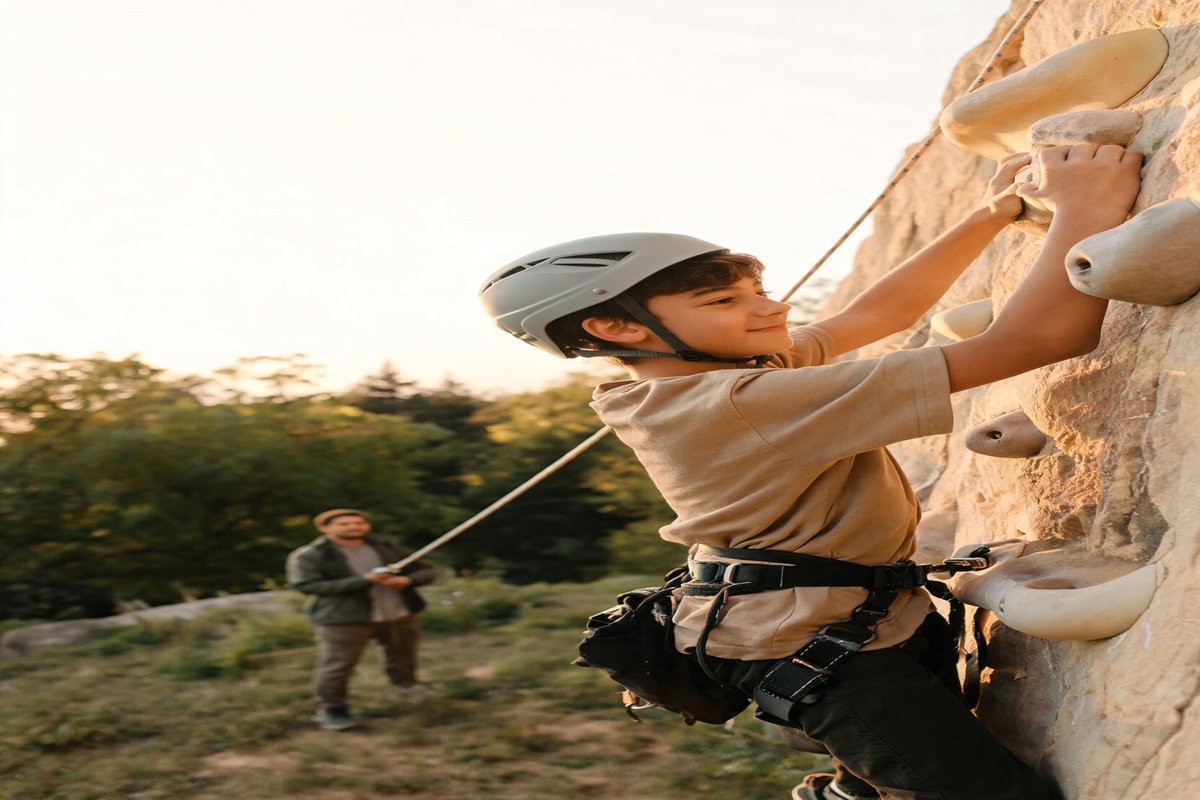
It was one of those evenings where the gym felt like a small city. Music humming, chalk dust floating in the light, a dozen kids shouting beta across the mats.
My friend’s daughter had just finished a hard bouldering circuit. She looked strong, focused, and thrilled. Then, on the walk to the car, the switch flipped. Tears, a headache, and a meltdown that came out of nowhere.
Her dad did what most of us do. He talked through dinner options, tried to solve the mood, tried to make the next morning easier.
But the real clue showed up when he said, almost apologetically, “She was up late again. Summer. Friends. Screens. You know.”
If you’re the climbing parent, you probably do know.
And you’ve probably wondered how much recovery really matters for a kid who climbs a couple days a week. The answer is: more than we want it to.
Not because your child needs a pro-athlete lifestyle, but because climbing is sneaky. It can look like play and feel like play, while still asking a lot from tendons, skin, nervous system, and attention.
This guide is a parent’s playbook for sleep and recovery that fits real life. No perfection. No guilt. Just a set of simple levers you can pull to get better sessions, fewer niggles, and a happier kid.
The recovery problem most climbing parents miss
In youth climbing, recovery usually gets discussed only after something goes wrong.
- A sore finger that sticks around.
- A kid who used to love the gym now drags their feet.
- A plateau that shows up despite “working harder.”
The mistake is assuming those problems come from lack of motivation, bad technique, or not enough training.
Often, the missing ingredient is the boring one: rest.
Here is the simple framework I use.
- Training is the stress. It breaks tissue down in tiny, controlled ways.
- Recovery is the adaptation. It rebuilds, and your kid gets stronger.
- If recovery is short, the body still adapts. But it adapts toward fatigue.
Kids can push through fatigue for a while. Then it shows up as crankiness, sloppy movement, and overuse pain.
Why climbing can be extra demanding
Climbing is not just cardio. It is not just strength. It is coordination, tension, balance, fear management, and decision-making.
That means fatigue can be physical and mental at the same time.
- Finger and forearm tissues get stressed even when the session looks “easy.”
- The nervous system is constantly solving problems.
- Falls, heights, and pressure can add an emotional load.
A youth climber who looks fine in the gym can still be running a deficit.
What “enough sleep” looks like for young climbers
Let’s keep this practical.
Your child’s exact sleep needs depend on age, growth, and personality. But for most school-age and teen climbers, these principles hold.
- Consistency beats hero nights. A regular schedule helps more than one giant sleep-in.
- Earlier is usually better. Late nights create more disruption than parents expect.
- Sleep is training. If you want better performance, this is the first place to look.
If you want an actionable target, aim for:
- A stable wake time within about 30 to 60 minutes most days.
- A bedtime that allows a full night with a little buffer for settling.
If that sounds vague, that’s intentional. The goal is not a perfect number. The goal is a pattern you can protect.
The “sleep bank” reality
Kids do not repay sleep debt like adults imagine.
A late bedtime on Friday does not magically disappear because your child sleeps until 10:30 on Saturday.
They might feel better, but their body is still playing catch-up. For climbing, that means:
- slower reaction time
- worse foot precision
- less patience for frustration
- higher injury risk on small holds
How to recognize recovery debt (before injury)
Young climbers rarely say, “I’m under-recovered.” They show you.
Here are the signs I’d watch for over two weeks.
Physical signs
- lingering soreness after an “easy” session
- finger, wrist, elbow, or shoulder discomfort that returns each week
- skin that tears more easily than usual
- frequent headaches after training
Performance signs
- foot slips that seem uncharacteristic
- loss of coordination on familiar climbs
- less willingness to try hard moves
- early pump on terrain that used to be fine
Mood and behavior signs
- bigger reactions to small setbacks
- negativity about practice that used to be fun
- more arguing about going to the gym
- falling asleep in the car on the way home
One of these once in a while is normal. A cluster of them is a message.
The parent decision framework: adjust what, and when
When a youth climber struggles, parents often choose between two extremes.
- Train harder. “Let’s push through it.”
- Stop climbing. “Maybe they need a long break.”
Most of the time, the best move is a small adjustment.
Here is a simple decision framework.
- Pain? If there is sharp pain, joint pain, or pain that changes movement, pause hard climbing and consider a coach or medical check.
- Mood change? If your kid is unusually irritable, anxious, or withdrawn, lighten the week and protect sleep.
- Plateau? If effort is high but results are flat, reduce intensity for 7 to 10 days and focus on skill and easy volume.
- Growth spurt? If your child is growing quickly, plan extra recovery. Growth is a stressor.
This is how you keep climbing in the long run.
Recovery levers you can actually control
You cannot control your child’s genetics or the school schedule. But you can control a few key recovery levers.
1) Sleep routine (the non-negotiable)
You do not need a perfect bedtime ritual. You need something repeatable.
Try this simple three-step routine:
- Downshift: 20 to 30 minutes of low-stimulation time.
- Body care: shower, teeth, a quick stretch if your kid likes it.
- Brain off: a book, quiet music, or a short chat about tomorrow.
If your child is older, involve them. Ask, “What makes it easier for you to fall asleep?” Let them pick two elements.
2) Fuel and hydration (especially after training)
Climbing parents often focus on pre-session snacks. The bigger impact is after.
A simple post-training meal or snack helps recovery and sleep.
- include carbohydrates to refill energy
- include protein to support rebuilding
- include water and a pinch of salt if it was a long, sweaty session
You do not need supplements for this.
3) Low-intensity movement (active recovery)
Kids recover well when they keep moving. The trick is keeping it easy.
Good active recovery options:
- a relaxed walk
- easy bike ride
- casual swimming
- light yoga or stretching
Avoid turning “recovery day” into another training day.
4) Stress load (school counts)
A school week can be harder than a climbing week.
When stress rises, recovery capacity drops.
If your child has exams, a tough social week, or travel, it is smart to reduce climbing intensity.
That is not coddling. It is coaching.
5) Schedule design (the hidden superpower)
Two mistakes show up constantly.
- Too many hard days in a row.
- Every session is intense.
If your kid climbs 2 to 4 days a week, aim for this pattern:
- one or two sessions can be “try-hard” sessions
- the other sessions should be technique-focused, easy volume, or playful
A simple weekly example:
- Day 1: skills + moderate climbing
- Day 2: rest or light movement
- Day 3: try-hard boulders or limit routes
- Day 4: rest
- Day 5: easy volume, games, movement drills
This keeps progress moving without grinding the body.
The difference between rest and laziness (and how to talk about it)
Some kids hear “rest” as “you are not tough enough.”
Some parents hear “rest” as “we are falling behind.”
Neither is helpful.
Here are phrases that work better.
- “Rest is part of training. It’s how your body gets stronger.”
- “We’re protecting your fingers so you can keep climbing.”
- “This week is a rebuild week. Next week we push again.”
If your child is competitive, frame recovery as strategy.
- “We’re doing what the best athletes do.”
- “We want you fresh for your hard session.”
A simple recovery plan for the next 14 days
If you want a concrete plan, try this two-week reset.
Step 1: Protect bedtime on training nights
Pick the nights your child climbs. On those nights, protect sleep.
- choose a realistic bedtime
- start the downshift routine 30 minutes earlier than you think you need
Step 2: Make one session intentionally easy
This is the most powerful change you can make.
Tell your child, “Today is an easy session. We’re practicing movement.”
Ideas for an easy session:
- silent feet drills
- easy traversing games
- repeating climbs at 70% effort
- focusing on breathing and pacing
Step 3: Add one recovery habit after every session
Pick one and keep it simple.
- a real meal within 60 to 90 minutes
- a shower and 5 minutes of stretching
- a short walk after dinner
Step 4: Check in weekly, not daily
Recovery is a pattern, not a mood.
Once a week, ask:
- “How did your body feel this week?”
- “Was there any pain that changed how you climbed?”
- “Did you feel excited to climb, or more tired?”
If the answers trend the wrong way, adjust the schedule.
When extra recovery is non-negotiable
There are seasons where you should assume your kid needs more rest.
- growth spurts
- new training phase (first time bouldering harder, first team program)
- competition season travel
- big school stress
In those windows, it can help to reduce intensity by 20% for a few weeks.
That might mean:
- fewer limit attempts
- shorter sessions
- more technique and less strain
This is how you stay healthy through the year.
The long view: raising a climber who lasts
The best youth climbers are not the ones who train the most.
They are the ones who stay healthy long enough to accumulate years of skill.
Sleep and recovery are how you protect that timeline.
If you take nothing else from this article, take this:
- Your child does not need more pressure. They need more support.
- A good week is not the hardest week. A good week is the week they recover from.
- Rest is not a break from training. Rest is training.
If you want, choose one small change this week. One bedtime protected. One easy session. One better post-climb meal.
You will likely notice it fast: steadier mood, more fun, and a kid who is ready to climb again.