
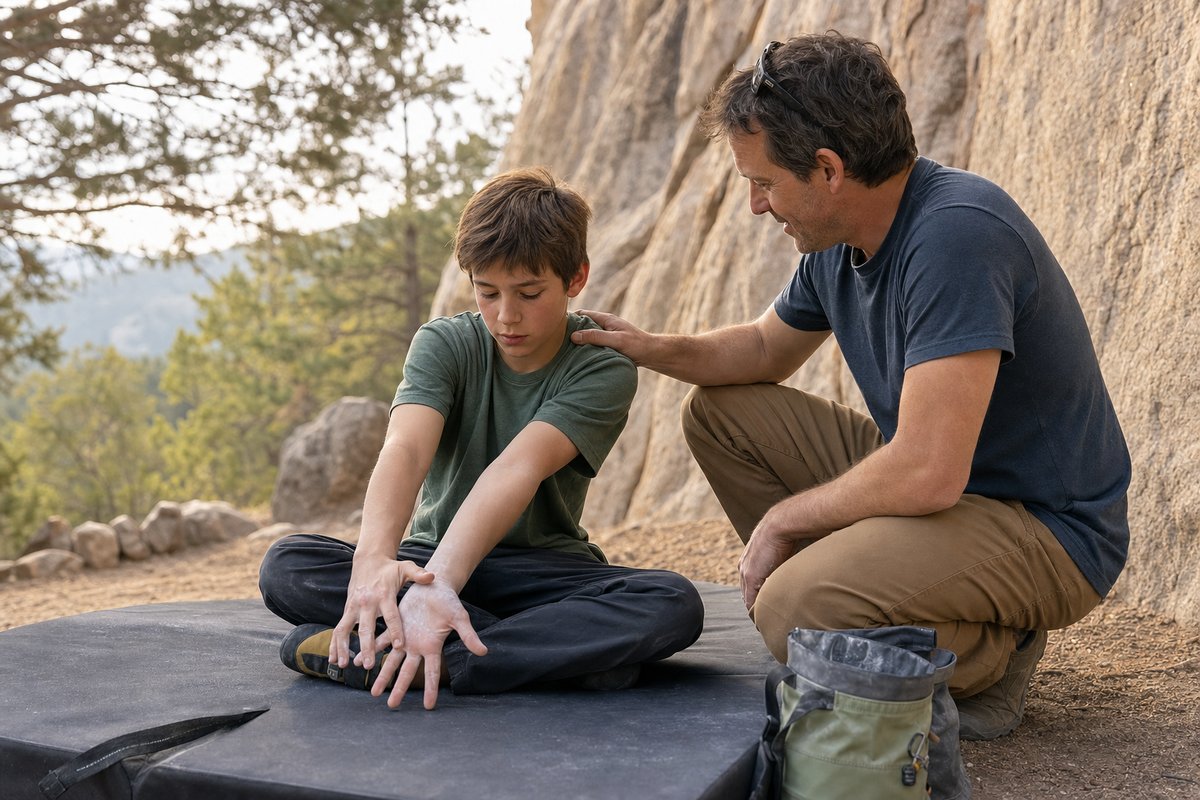
Skip the campus board while your climber is still growing. Box jumps and clapping pushups build the snap of a dynamic move without yanking on small rungs.
A campus board trains explosive pulling with the feet off and the fingers doing the catch. That load is a poor match for hands that are still growing. The power you wanted from the board can live in the legs and the shoulders instead.
Key takeaways
- A campus board asks the fingers to catch a moving body. Growing hands are the wrong tool for that job.
- Box jumps train a quick push from the legs. Clapping pushups train a quick push from the upper body.
- Keep the box low, the landings quiet, and the sets short. Step down instead of jumping down.
- On the wall, use big holds and let the feet do the work. Leave feet-off dynos on small edges alone.
- Finger pain is a reason to stop and get the hand checked. It is not a reason to campus "carefully."
What is a campus board asking the body to do?
A campus board is a ladder of rungs you pull between, often with your feet hanging free. The drill is meant to make contact strength and the pop from one hold to the next.
The catch is the dangerous part for a young climber. The whole body arrives on a few fingers, fast. Adult climbers argue about how much of this drill they need. For a child or a teen who is still growing, the argument can wait. The board is a specialty tool for mature hands, used with a coach who already knows that athlete. It is not a garage project because a video looked powerful.
The same pattern shows up off the wooden board. Feet-off double dynos on small edges, and campusing the first moves of a boulder, ask the fingers for the same sudden catch. If you are banning the board at home, ban that version in the gym too.
Why are growing hands a poor match for it?
Growth areas in the finger bones stay open through the teen years for many climbers. They do not close on a birthday you can circle on a calendar.
Those areas are less ready for a sudden, high force than mature bone. Repeated hard crimps and dynamic catches are the loads coaches worry about. A child who feels strong can still be in that window. Strength on big holds does not tell you the growth areas have fused.
This page cannot tell you whether a given hand is ready. A clinician who can examine your child is the person who comments on pain. A coach who knows youth athletes is the person who comments on training. A parent with a screwdriver and a set of rungs is not either of those people.
Read finger strength training for young climbers before anyone adds finger-specific work. Climbing on a mix of holds, with the feet on, is the usual path. A campus ladder is not the starter version of that path.
How do box jumps replace the pop?
Box jumps train the fast leg drive that starts a dynamic move. The fingers never take the catch.
Use a stable box, a gym plyo box, or a single sturdy step that will not tip. Stand close enough to spot a miss. Clear toys, bags, and little siblings out of the landing zone. A wood floor or a gym floor is fine. Skip loose rugs. Skip concrete if you have a better surface.
Cue one idea. Land quietly, with the knees bending and both feet hitting together. The height is a side effect of a clean jump. It is not the score.
Cap a set at a handful of jumps. Rest long enough that the next set looks like the first. Two or three sets is a full serving. Then stop. If the landings get loud, the knees cave, or they start leaping from too far away, the set is already over.
Step down. Jumping off the box is a second landing they do not need. A low step that they can control beats a tall box they survive.
One or two days in a week is enough, on fresh legs. Put the jumps after a general warm-up and before they are cooked from a long session. Easy jogging in place, a few slow squats, and a couple of step-ups are plenty of warm-up for this. Do not add jumps at the end of a three-hour gym night.
If a clinician has limited jumping because of a knee, ankle, or back issue, follow that limit. These drills are ordinary athletic play a parent can watch. They are not rehab, and they are not a test.
How do clapping pushups fit?
Clapping pushups train a fast push from the upper body. The hands leave the floor and land on flat palms. They do not catch a rung.
Start from a pushup your child can already do with a straight body. If the hips sag or the chin dives, they are not ready for a clap. Use a quicker pushup from the knees, or a pushup with the hands on a sturdy bench, just fast enough that the hands get light. The clap itself can wait.
When the regular pushup is solid, try one rep where the hands pop off the floor and land softly, shoulder width, on full palms. Fingertips are out. A clap in the middle is a flourish you add only after the landing is already calm.
Keep the sets short. A few clean reps, a real rest, and maybe one more set. Two days in a week is the top end if they are also climbing. Stop when the lower back folds or the last rep looks like a collapse. Shoulders and wrists should feel worked, not sharp. Sharp pain ends the drill for the day.
Do this on the floor. Do not put the hands on a campus board, on rings, or on a stack of books. The whole point is a stable surface.
Where do these drills sit in a climbing week?
Treat them as a short power snack, not as a second sport.
A simple pattern is one power day on a day they also climb easy, or a separate ten to fifteen minutes at home. Hard bouldering and a max jump contest on the same afternoon is too much pop for one day. Pick one.
They still climb. Big holds, quiet feet, and moves that start from the legs teach the timing a campus board pretends to skip. A coach can add a controlled dynamic move on jugs when the climber already knows how to fall and how to keep the shoulders engaged. That is a movement lesson. It is not a feet-off ladder.
If they leave the session still joking, you chose the right dose. If they are fried, short the next week. Power work is optional. A happy climber on large holds is the thing you are protecting.
The weekly shape, including how many days they show up, belongs in a plan you can actually keep. The finger article covers what to do about contact on real holds, and when to wait. Use finger strength training for young climbers for that decision. Use the jumps and the pushups when someone at the gym says your child "needs power" and points at a campus ladder.
When should you skip the substitutes too?
Skip the jumps and the pushups when something already hurts, when a clinician has said no, or when your child turns every drill into a height contest you cannot steer.
Also skip them in a week when climbing itself looks clumsy and sore. A fast growth stretch is a time for simpler climbing, not for a new explosive hobby. Pain in a finger joint, swelling, or pain that shows up the next morning means you stop loading that hand and you get it looked at. You do not manage that pain with a lower box.
A team station is not a permission slip. If the squad files onto a campus board, you can tell the coach your child will do the jumps or sit that station out. Plenty of careful youth programs never campus their younger athletes. Yours can be one of them even if the printed workout forgot.
FAQ
Are campus boards ever reasonable for teenagers?
Sometimes, for an older teen, with a coach, after someone qualified has judged that the hands and the training age are ready. A parent should not make that call from a video or from a grade. A past finger injury needs a clinician's clearance before rungs enter the conversation at all.
Do box jumps build finger strength?
No. They build leg power you can use to start a move. Finger strength for a young climber is mostly time on the wall with the feet on, and it has its own rules. Those rules are in the finger strength guide.
My child can already campus. Should I let them keep going?
If they are still growing, stop the board. Being good at a risky drill is not a reason to keep it. Offer the jumps and the pushups, and keep climbing on holds that the feet can share.
How high should the box be?
Low enough that every landing is quiet and in the same spot. A stair step is enough for a first month. Raise it only when the low step looks boring and the landings are still soft. If they miss, the box is too high.
Can they do clapping pushups every day?
No. A couple of short sessions in a week is plenty, with ordinary days off. Daily explosive pushing is how shoulders get cranky. Wrist or elbow pain ends the drill until it settles, and pain that sticks around gets checked.
What if the gym team programs campus workouts?
Ask which ages do that station and what the younger athletes do instead. You can decline the board without declining the team. Tell your child ahead of time so they are not improvising in front of friends.
The Belay is the free YouthClimbing.com newsletter for parents. Notes on gym sessions, kids' gear, safety, and the youth season go out as new guides are published. Join The Belay. You can unsubscribe any time.