
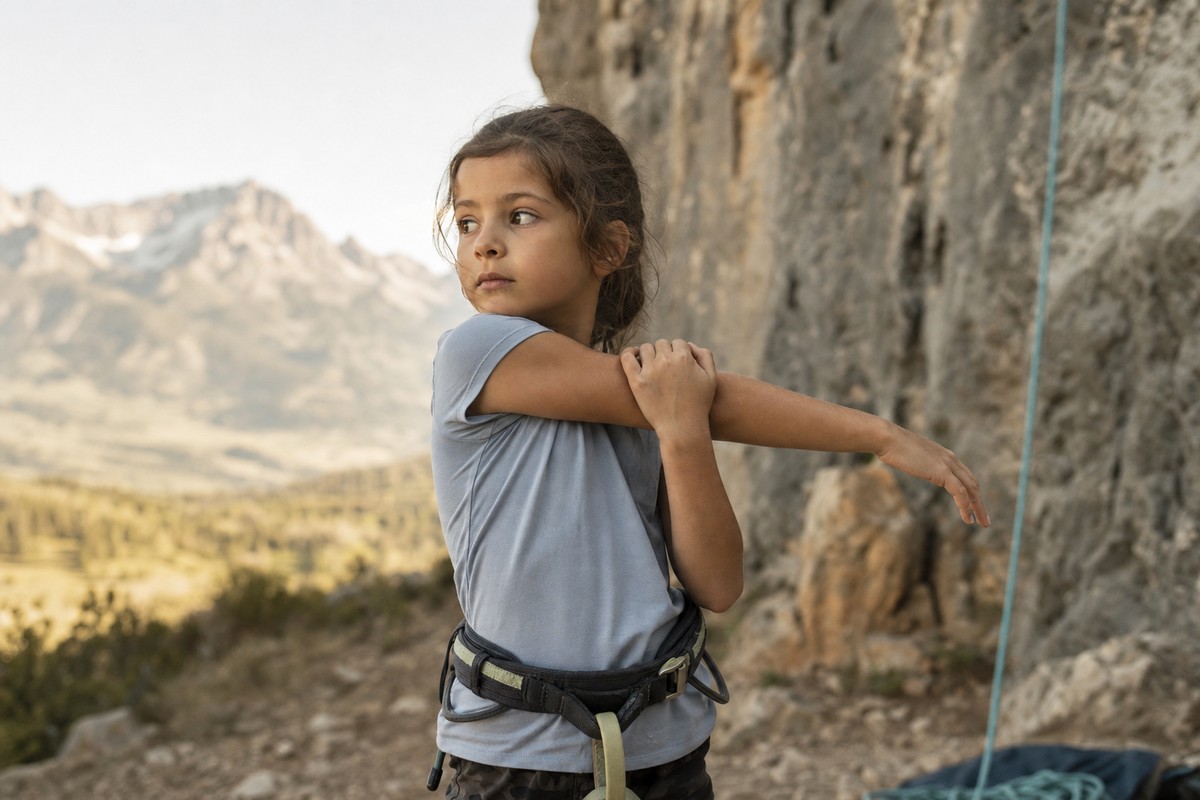
The last regional of the season wraps up, your kid peels off their shoes in the car, and about ten minutes later asks the question you were not ready for: "So what do I do now?" No more team practice on the calendar for a few weeks. No more meets to point toward. Just a kid who has spent the last several months organized around climbing, suddenly untethered from it.
This is the part of the year nobody puts on a poster. Gyms market the season. Coaches build the practice plan. But the gap between seasons, the off-season, is where a lot of a young climber's long-term durability actually gets decided. Handled well, it is a reset that makes next season better. Handled poorly, either by doing nothing or by quietly climbing just as much as always, it can set a kid up for exactly the overuse problems the off-season is supposed to prevent.
Key Takeaways
- The American Academy of Pediatrics recommends youth athletes take at least 1 to 2 days off per week from their primary sport, plus roughly 3 total months of downtime a year, spread across the calendar rather than taken all at once.
- A 2020 case-control study in the Orthopaedic Journal of Sports Medicine found young athletes whose weekly training hours exceeded their age in years, or whose ratio of organized sport to free play exceeded 2 to 1, were more likely to develop overuse injuries.
- Off-season does not mean zero climbing. It means a deliberate drop in volume and intensity, with room for other movement.
- Cross-training in the off-season is not about building a stronger climber in six weeks. It is about giving overworked tendons, growth plates, and motivation a real break while keeping general fitness up.
- The parent's job in the off-season is smaller than it feels: protect the rest, offer variety, and stay out of the way of a kid's own recovery.
Why an off-season matters for a sport that uses the same joints every session
Climbing is repetitive in a specific way. The same fingers, the same shoulders, the same small stabilizing muscles in the forearm get loaded session after session, year-round if a kid trains through every break. Growing bodies are more vulnerable to that repetition than adult bodies, because growth plates and developing tendons do not tolerate the same training load an adult's would.
Joel Brenner, a former chairperson of the American Academy of Pediatrics Council on Sports Medicine and Fitness, put it plainly in coverage of the AAP's youth sports guidance: playing multiple sports, at least until puberty, decreases the chances of injuries, stress, and burnout. Climbing coaches who have been doing this a long time will tell you the same thing in different words: the kids who last are rarely the ones who never took a break.
How much rest does a young climber actually need?
The American Academy of Pediatrics' clinical guidance on sports specialization recommends youth athletes get at least 1 to 2 days off per week from their primary sport, along with roughly 3 total months of downtime spread across the year in smaller chunks, rather than crammed into one long stretch. That is a guideline, not a rulebook, but it is a useful anchor when a kid (or a kid's coach) is pushing for year-round training with no real gap.
A 2020 case-control study published in the Orthopaedic Journal of Sports Medicine followed young athletes for three years and found a consistent pattern: athletes whose weekly training hours outpaced their age in years, and athletes whose ratio of organized sport to unstructured free play went above 2 to 1, were more likely to develop injuries, including overuse injuries. A simple version of that rule for a climbing family: if your 11-year-old is training climbing more than 11 hours a week with almost no unstructured play mixed in, that combination is worth a second look, not because 11 hours is automatically dangerous, but because the ratio itself is a documented risk marker.
None of this means the off-season should be all rest and no movement. It means the off-season is the window to trade sport-specific repetition for broader, lower-impact activity, then bring your kid back to the wall with fresher joints and, often, more enthusiasm than they left with. For the week-to-week version of this same idea, our guide to sleep and recovery for young climbers covers how rest works inside a single training week, not just across a whole season.
What actually counts as good cross-training for a young climber
Not every off-season activity is equally useful. Some choices genuinely support a climber's return to the wall. Others just move the repetitive strain somewhere else.
- Swimming. Full-body, low-impact, and easy on joints that have been loaded all season. It builds general cardiovascular fitness without adding grip or finger stress.
- General strength and bodyweight work. Squats, push-ups, rows, and core work that target the muscles climbing tends to neglect, like the chest, quads, and opposing back muscles, help build a more balanced athlete instead of an overspecialized one.
- Running or biking. Good for aerobic base and mental variety. Neither loads the fingers or shoulders the way climbing does, which is exactly the point.
- Yoga or mobility work. Helps with the shoulder and hip mobility that climbing rewards, without adding load to already-worked tendons.
- A completely different sport, for a season. Soccer, gymnastics, dance, martial arts. Anything that gets a kid moving in new patterns, around new teammates, without climbing on the agenda at all.
- Unstructured free play. Genuinely unscheduled time, the kind that does not show up on a training log, is part of what the specialization research above is measuring. It matters more than it sounds like it should.
What tends not to help: quietly climbing at the same volume under a different name, like calling twice-a-week "just for fun" sessions an off-season while the actual hours barely change. That is not cross-training. That is the same load with a different label.
Building a simple off-season plan
You do not need a periodized training calendar to do this well. A workable framework looks like this:
- Take a real first week off. No climbing, no structured training. Let your kid be bored, sleep in, or ask to go back to the gym on day four. Both reactions are fine and tell you something.
- Pick one or two cross-training activities your kid actually likes. A reluctant swimmer who is forced into a pool three times a week will not get the recovery benefit. Motivation matters as much as the activity itself.
- Keep climbing in the mix at a lower dose, if your kid wants it. A once-a-week casual session for fun is very different from twice-weekly structured team training. If your gym or team offers optional off-season open climbing, low-pressure and no-agenda is the right frame for it.
- Watch for signs your kid needs more time, not less. Persistent finger or elbow soreness, a flat mood about climbing, or a kid who is dragging their feet to a sport they used to love are all signals to extend the break rather than push through it.
- Let the calendar, not the anxiety, set the return date. If team practice restarts in six weeks, six weeks is the plan. Resist the urge to have your kid "get ahead" by training climbing hard for the last two weeks of a supposed break.
What if my kid does not want to stop climbing at all?
Some kids genuinely love the gym more than any other activity, and forcing a full stop can backfire into resentment. That is a fair concern, and the answer is not to override your kid's enthusiasm. It is to change the shape of what they are doing. A kid who wants to be at the gym constantly can still get an off-season if the sessions shift from structured, coached, competition-focused training to open, social, low-stakes climbing with friends. The joints get a break even if the kid does not leave the building. What matters is dropping the intensity and structure, not necessarily the location.
The big picture
An off-season is not a punishment and it is not wasted time. It is the part of a young athlete's year that protects the parts of them a competition season quietly uses up: growing joints, unstructured creativity, and plain enthusiasm for a sport they chose. A kid who cross-trains through a real off-season most years tends to arrive at the next season with more room to grow, not less, because they are not managing chronic soreness or a flicker of burnout on top of everything else a new season asks of them.
You do not need to engineer this perfectly. Pick some variety, protect a real chunk of downtime, and let your kid have some input into what that time looks like. The climbing will still be there in six weeks. A body and a motivation that got a genuine break usually come back stronger than one that never stopped.
Frequently Asked Questions
How long should a young climber's off-season be?
The American Academy of Pediatrics recommends roughly 3 total months of downtime a year from a primary sport, spread across the calendar rather than taken in one block. For most youth climbers, that might look like a few shorter breaks around each competition season rather than one long stretch.
Is it bad for my kid to keep climbing casually during the off-season?
No. Casual, low-structure climbing without team training or competition pressure is different from year-round structured training. The goal is lowering volume and intensity, not eliminating climbing entirely, especially for a kid who genuinely enjoys the gym.
What is the age-in-years training rule for youth athletes?
It is a rough guideline from sport specialization research suggesting weekly training hours should not consistently exceed an athlete's age in years. An 11-year-old training climbing 11-plus hours a week, with little unstructured free play, is a combination linked to higher overuse injury risk in a 2020 case-control study.
What cross-training activities are best for young climbers specifically?
Swimming, general bodyweight strength work, running or biking, yoga, and a season of an entirely different sport all give climbing-specific joints a break while keeping general fitness up. Avoid anything that just moves the same grip and shoulder stress somewhere else.
How do I know if my kid needs more rest, not less?
Watch for persistent finger or elbow soreness, a flat or reluctant attitude toward a sport they used to love, or complaints that do not resolve with a normal weekend off. Any of those are reasons to extend a break rather than push through it.
Will taking a real off-season hurt my kid's competitive progress?
The research points the other way. Athletes who train without real breaks show higher rates of overuse injury, which costs far more competitive time than a deliberate, well-timed off-season ever does.
Sources
- American Academy of Pediatrics clinical guidance on sports specialization, as reported by Healio
- Jayanthi N, Kleithermes S, Dugas L, Pasulka J, Iqbal S, LaBella C. "Risk of Injuries Associated With Sport Specialization and Intense Training Patterns in Young Athletes: A Longitudinal Clinical Case-Control Study." Orthopaedic Journal of Sports Medicine, 2020