
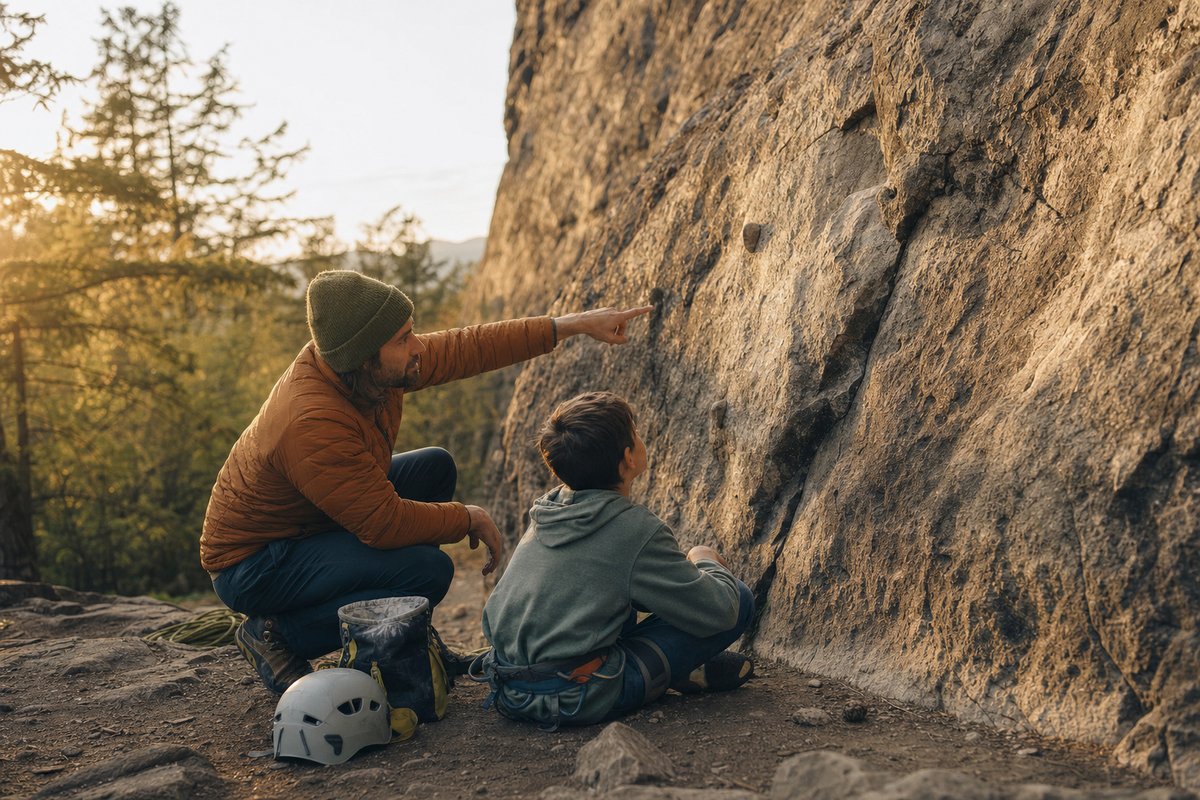
The notebook in the gym bag
The car is quiet on the way home from Thursday practice. Your kid is staring out the window, and you ask the usual question. "How was it?" The answer is the usual one too. "Good." You try again. "Did you get that purple one you were working on?" A shrug. "I don't remember which one was purple."
Two weeks later, the same route is still on the wall. Your kid falls at the same move, in the same way, and comes off the mat frustrated that nothing is changing. The truth is that something did change on that first try. They figured out half the sequence. They just never wrote it down, so the lesson evaporated somewhere between the gym and dinner.
This is where a climbing journal earns its spot in the gym bag. Not a training log full of numbers. Not a diary you read over their shoulder. Just a small notebook where a young climber jots down what they tried, what worked, and what they want to try next time. For the climbing parent, it can also be the thing that finally turns "good" into a real conversation.
Key Takeaways
- A climbing journal is a short note after a session, not a homework assignment. Three to five minutes is plenty.
- Reflection helps people keep what they learn. In one workplace study, trainees who spent 15 minutes a day writing about what they learned did 23 percent better on a final test.
- The habit is less common than you might expect. In one 2026 survey of 53 teenage athletes in a national talent program, 62 percent did not keep a training diary.
- The journal belongs to the climber. Your job is to supply the notebook and the time, not to grade the entries.
- Over a season, the notes show patterns no one remembers on their own: which moves keep stopping them, how sleep and mood affect sessions, and how far they have come.
Why writing it down helps
Every boulder and route is a small puzzle, and kids solve those puzzles in pieces across many sessions. Between school, friends, and everything else, the details of a Tuesday session are often gone by Thursday.
Writing a few lines after climbing works like saving your progress in a video game. The next session starts where the last one ended.
There is research behind the idea that reflection helps learning stick. A team of researchers from HEC Paris, Harvard Business School, and the University of North Carolina ran a field experiment at a large outsourcing company in India. Employees who spent the last 15 minutes of each training day writing and reflecting on what they had learned did 23 percent better on the final training test than other employees. That study was about adults learning a job, not kids learning to climb, so treat it as a general lesson about reflection rather than a climbing result. Still, the core idea carries over well. Pausing to put an experience into words helps people understand it and use it later.
The flip side is how rare the habit is in youth sport. In a 2026 study published in PLOS ONE, researchers surveyed 53 athletes in England Athletics' Youth Talent Programme, a group of promising teenage track and field athletes. Sixty-two percent of them did not keep a training diary. These were talented, coached young athletes, and most of them still did not keep a diary. It is one small study in one sport, but it suggests the habit is easy to skip even at a high level. A simple journal gives your kid a tool that many young athletes go without.
What goes in a climbing journal
Keep the format simple enough that a ten-year-old can fill it in standing next to the car. Here is a starting template that works for most ages:
- Date and place. Which gym or crag, and whether it was practice, a class, or a free climb session.
- How I felt coming in. One word is enough. Tired, excited, grumpy, strong.
- One climb I worked on. A color, a number, or a nickname they give it. "The pink one by the cave" counts.
- What worked. A move, a foot placement, or a rest spot that clicked.
- What stopped me. The exact spot where they fell or got stuck, in their own words.
- Next time I want to try. One idea, not a list.
- Anything that hurt. A quick note if a finger, shoulder, or knee felt off. This is not for diagnosis. It is just a record you and the coach can look at later.
That is the whole thing. Most entries will take under five minutes. Some will be two words long, and that is fine. The habit matters far more than the length of any one entry.
Matching the journal to your kid's age
A seven-year-old and a fifteen-year-old need very different versions of this. A good rule is to start smaller than you think and let your kid add more when they want to.
- Ages 5 to 8: draw it. Young climbers can sketch the wall, color in the holds they used, or put a sticker on the routes they finished. A parent can write one sentence they dictate. The goal is simply connecting the act of climbing with the act of remembering it.
- Ages 9 to 12: three lines. One climb, one thing that worked, one thing to try next time. Kids this age often like checklists and little boxes to tick. A pre-printed card taped inside a notebook can make the routine feel easy.
- Ages 13 and up: their own system. Teens may want to track more detail, such as grades, attempts, training sessions, or sleep. Some prefer a notes app on their phone. Let them choose. A teen who designs their own format is far more likely to keep using it.
- Competitive team climbers: add the coach. If your kid trains on a team, the journal can include the coach's drills and feedback from practice. Bringing a few notes to a check-in makes talking to your kid's climbing coach much more specific.
The parent's role: supply, don't supervise
Here is the hard part for many climbing parents. The journal only works if it belongs to your kid. The moment it feels like a report card, it stops being honest, and soon after that, it stops being written at all.
- Buy the notebook, then step back. Let your kid pick it out if possible. A small, sturdy one that fits in a chalk bag pocket or gym bag works best.
- Protect the time, not the content. Offer five quiet minutes in the car or at the kitchen table after climbing. You make room for the habit. They decide what goes on the page.
- Ask before you read. Some kids love sharing their journal. Others want it private. Either is fine. A simple "Want to tell me about any of your notes?" leaves the door open without forcing it.
- Use the notes as a conversation starter, not a correction. If your kid wrote "fell at the big reach again," resist the urge to coach. Try "What do you think you'll try next time?" instead.
- Never compare entries to a sibling or teammate. The journal measures your kid against their own past, not against anyone else.
- Model it if you climb. If you climb too, keep your own notebook. A parent jotting notes after a session makes the habit look normal, not like an assignment.
How to keep the habit going
The first few weeks are when a new journal is most likely to slip. A few small tricks help the routine survive a busy season.
- Attach it to something that already happens. Journal right after taking off climbing shoes, or during the first five minutes of the drive home. Same time, same place, every session.
- Keep the pen with the notebook. A journal with no pen nearby is a journal that does not get written in. Tie one on with a string if you have to.
- Lower the bar on hard days. On tired days, one word or one doodle still counts. A tiny entry keeps the streak alive.
- Look back together once a month. Flip through the past few weeks. Kids are often surprised to see that a climb that felt impossible two months ago is now a warm-up. That moment of seeing their own progress is the real payoff.
What the journal can show you over time
After a few months, a stack of short entries turns into a useful record. You and your climber may start to notice patterns that no one would remember on their own.
- Recurring sticking points. If "fell on the big reach" shows up six times, that is a specific skill to work on, and a great question to bring to a coach. It can also pair well with video review at home, since the notes tell you which moments are worth filming.
- Energy and mood trends. A string of "tired" or "didn't want to go" entries can be an early sign that the schedule is too full. That is worth noticing early, and our guide to youth climber burnout covers what to watch for next.
- Small aches that keep coming back. A finger that "felt weird" in three different entries is worth mentioning to a coach or a doctor. The journal does not diagnose anything, but it gives the adults around your kid a clearer picture.
- Real proof of progress. Many kids judge themselves by their latest tough session. A journal gives them evidence that they are improving, even during a plateau.
Common worries, answered honestly
A few concerns come up often when parents first suggest a journal.
- "My kid hates writing." Then skip the writing. Drawings, stickers, voice memos, or a one-word rating all work. The point is reflection, not handwriting practice.
- "Won't this add pressure?" It can if you make it about performance. Keep entries focused on what your kid noticed and enjoyed, not on grades sent. If your kid starts to dread it, pause for a while.
- "My kid is too young to understand reflection." Even very young climbers can answer "What was your favorite climb today?" That is reflection. It just looks simpler at age six.
The long view
A climbing journal is not about logging every route or squeezing more training out of a young climber. It is about helping your kid build a quiet, lifelong skill: noticing what happened, thinking about why, and deciding what to try next. That skill shows up on the wall, but it also shows up in schoolwork, friendships, and every other hard thing they will learn.
Years from now, that battered little notebook may be one of the best things your kid keeps from these seasons. Not because of the grades written in it, but because it holds their own voice at nine or twelve or fifteen, figuring things out one problem at a time. For the climbing parent, the investment is small. A notebook, a pen, and five minutes of patience after practice. What your kid builds with it is up to them, and that is exactly the point.
Frequently Asked Questions
What is a climbing journal for kids?
It is a small notebook where a young climber writes or draws a few notes after each session: what they climbed, what worked, what stopped them, and what they want to try next. It is a reflection tool, not a test or a training log full of numbers.
How long should a climbing journal entry take?
Three to five minutes is plenty. Some days an entry will be one word or a quick sketch, and that still counts. A short, steady habit is more useful than long entries that happen once a month.
At what age can a child start a climbing journal?
Kids as young as five can start with drawings or stickers, with a parent writing down a sentence they dictate. Kids around nine to twelve can usually handle a simple three-line template, and teens often prefer to design their own format or use a notes app.
Should parents read their child's climbing journal?
Ask first. Some kids love to share their notes, and others prefer to keep them private. The journal works best when it belongs to the climber, so treat reading it as an invitation, not a right.
Does keeping a journal actually help young climbers improve?
There is no climbing-specific study on it that we could find. Broader research suggests that writing and reflecting on what you learned can help people retain and use it, and a journal gives kids, parents, and coaches a clear record of sticking points and progress over time.