Your climber is two moves up a slab they have done before. They freeze. You can see the breath go high and tight. From the ground you want to say something useful, and every sentence you try sounds like either a pep talk or a correction. They come down, sit, and say they "just cannot think."
That is a mental-training moment, and it is not the same as a scored isolation lobby. Meet-day nerves have their own page. This page is for the ordinary Tuesday: how a young climber learns to notice a spike, pick one cue, and keep climbing without turning the sport into a second homework class.
Our training guide already names two tools: pre-climb visualization, and 4-4-4 breathing. This post shows parents how to use those tools without inventing a psychology practice in the kitchen.
Key Takeaways
- The AAP's Parenting an Athlete page tells parents that support must be unconditional, and that a child needs self-worth that is not dependent on the sport.
- AAP physician Paul Stricker, on HealthyChildren.org's Eyes on the Prize, wrote that when a child hears high expectations, "he can become fearful of not being able to live up to those expectations." Fun, win or lose, is the factor that lowers that stress.
- This site's mental-game tools are small on purpose: see the first moves, breathe 4-4-4, ask "what is the next hold," not "will I send."
- Meet-day scripts live in Beating Competition-Day Nerves. Do not copy that hour onto every practice.
- This is education, not therapy. Persistent worry, panic that does not fade, or any talk of self-harm is a pediatrician and 988 conversation. The Belay is the only current digital product. There is no mental-training app here.
What mental training is, and what it is not
Mental training is rehearsal. A climber looks at a sequence, pictures the first three moves, and notices where fear usually shows up. Then they climb. Then they say one true sentence about what they did, not a story about who they are.
It is not a personality makeover. It is not "mental toughness" as a way to ignore pain. It is not a substitute for a coach, a rest day, or a clinician. If a child is not sleeping, not eating, or not wanting to see friends, you are outside this article. Call their doctor.
Joel Brenner, in the AAP burnout news summary, said some youth feel pressure to measure success only by performance. Mental training that only exists to chase a score will recreate that pressure with nicer vocabulary. The point is a kid who can stay present on a hard move.
Three tools that already live on this site
Keep the list short so a ten-year-old can remember it.
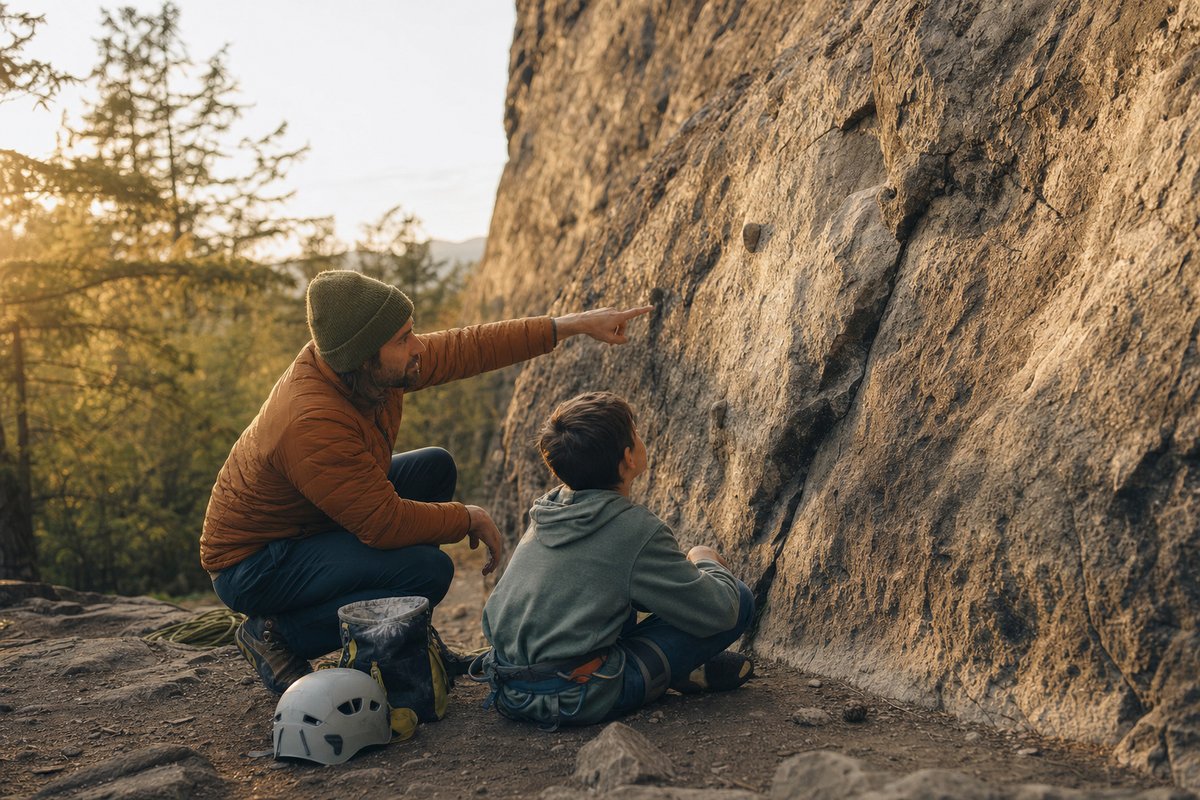
- See the first three moves. Visualization on our training page means rehearsing the sequence before leaving the ground. For younger kids, make it literal: "Which foot first? Which hand second?" They do not need to close their eyes in the gym if that feels weird. Looking at the holds and pointing is enough.
- Breathe 4-4-4. In for 4, hold for 4, out for 4. Practice it in the car or at bedtime once or twice so the first time is not mid-panic on an overhang. If counting breath makes your child more anxious, drop it. Breath work is optional. It is not a moral test.
- Name the next hold, not the grade. Process over outcome is already in the training guide. "Did I try the heel?" beats "Did I send?" AAP sports pages keep repeating the same idea in pediatric language: emphasize fun and effort, not a win-at-all-cost frame.
That is the whole starter kit. You do not need a journal app, a sports psychologist on retainer, or a laminated mantra. If a coach already has cues, use theirs. Two systems is worse than one.
How a parent runs this without becoming the coach
Your job is setup and tone, not play-by-play.
- Ask once, before the session: "Want a reminder of the three-move look, or do you want to handle it?" Consent matters. Surprise coaching from the couch does not.
- After a fall, wait. Let them speak first. Video review at home uses the same order: their eyes, then yours.
- Save technique lectures for the coach. Mental training is not a back door for beta.
- Skip it on the days they are already done. A flooded kid cannot store a new cue.
Positive Coaching Alliance tells first-time sports parents to avoid shouting instructions and to let coaches coach. The same rule applies to "relax" yelled from a bouldering pad. That word is not a skill. A breath count or a next-hold cue is.
Adjusting for age
Under about 10, keep it physical and short. Point at holds. Take one silly breath together. Celebrate a try that used the plan, even if they fell.
Late elementary and middle school can handle a two-minute pre-climb look and one sentence after. They still should not be writing performance essays.
Teens who compete can layer in meet-day work from the nerves guide: isolation, warmup, and what you will not say in the lobby. The weekly practice version stays smaller than the meet version on purpose. If every Tuesday feels like finals, you are not training the mind. You are exhausting it. That is the burnout post's territory.
When this is not the right tool
Mental training does not treat an anxiety disorder, depression, ADHD, or trauma. It does not treat a finger that hurts. If fear of falling is new after a bad drop, talk with the coach about structured fall practice, and talk with a clinician if the fear follows them into school or sleep.
HealthyChildren.org says extra support is worth seeking if worry gets in the way of ordinary activities. That is the line. Not "zero nerves." Interference with life.
The long view
The useful end state is a climber who can notice "I am spun up," pick one cue, and try the next move. That skill travels to tests, new schools, and the first job interview. It does not require a branded mental-training system.
Use the tools on the wall. Use The Belay if you want parent notes in your inbox. That newsletter is what exists. A proposed pocket card with the three cues might be worth making later. It is not for sale, and it is not a substitute for a doctor when the worry is bigger than a boulder problem.
Sources
- American Academy of Pediatrics, "Parenting an Athlete," HealthyChildren.org
- Paul Stricker, "Eyes on the Prize," HealthyChildren.org
- Positive Coaching Alliance, "10 Tips for First-Time Sports Parents/Caregivers"
- YouthClimbing.com, Youth Climbing Training Guide (mental-game section)
- YouthClimbing.com, Beating Competition-Day Nerves: A Parent Guide
Frequently Asked Questions
What is mental training for a youth climber?
It is practice for attention, breathing, and self-talk, the same way footwork is practice for the feet. On this site that means visualization, a simple breath count, and process goals. It does not mean diagnosing anxiety or turning the living room into a performance lab.
Is this the same as competition-day nerves?
No. Meet-day jitters have their own guide. This page is the week-to-week version: how a kid learns to notice a spike of fear on a gym boulder, reset, and try the next move. Use both if you compete. Use this one if you never plan to.
What is the 4-4-4 breathing protocol?
It is already on our training guide: breathe in for 4 seconds, hold for 4, breathe out for 4. Parents can practice it in the car so it is not a new trick on the wall. If breath work makes a child more panicked, stop and talk with their pediatrician.
Can mental training fix a scared climber?
It can give them a next step. It cannot erase fear, and it cannot treat an anxiety disorder. The AAP tells parents that some nerves before a hard thing are normal, and that worry which takes over sleep, school, or play needs extra support. That support is clinical, not a visualization script.
Should parents lead mental training at home?
Keep it light and optional. Two minutes of seeing the first three moves before a session is plenty. If your child has a coach, ask what cues they already use and do not invent a second system. Video review at home is a related tool, not a replacement for this.
Do we need an app or a mental-training download?
No. Nothing like that exists on this site. The Belay newsletter is the only current digital product. A proposed future card might list the three cues in this article. It would be labeled as a proposal, not as a product you can buy today.