
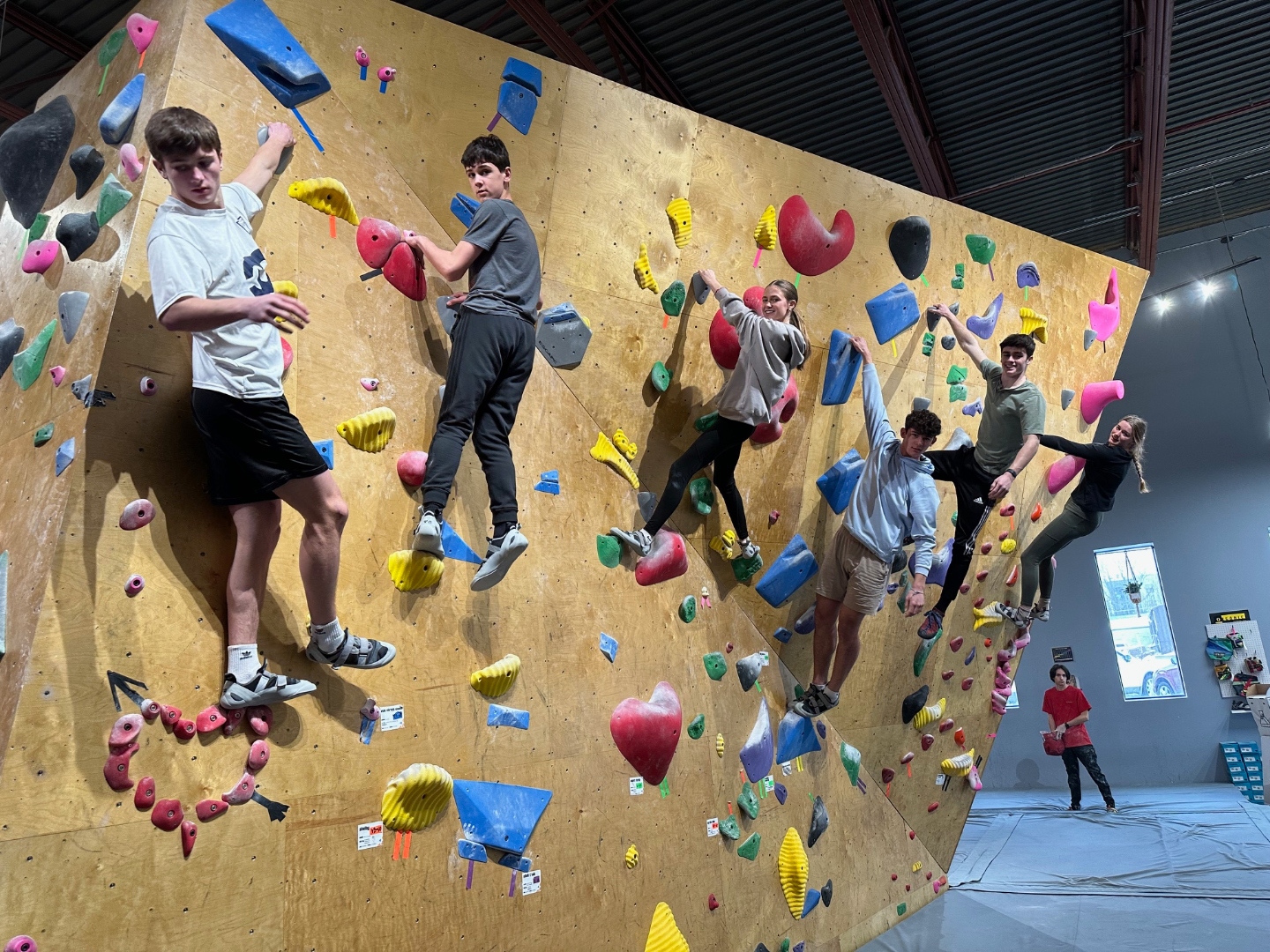
Your kid has been in the gym's rec class for four months. Tonight, the coach who runs it waves you over at pickup and says, "She's strong. We'd love to have her try a team practice next week." Your kid is already vibrating with excitement in the car. You are running a very different set of questions: What does "team" even mean at this gym? What does it cost? Who is actually watching my kid on that wall?
This post is for the climbing parent standing in that exact spot: excited for your kid, and unsure how to tell a well-run program from one that just has a good sales pitch.
Key Takeaways
- A 2016 Climbing Business Journal survey of gym program directors found the average coach-to-athlete ratio on youth teams runs about 1:6. That number is worth asking about directly, since it varies a lot by gym.
- USA Climbing's Youth Series and Elite competitor membership costs $110 for the 2026-2027 season, according to the official USA Climbing memberships page, and that is separate from whatever a gym charges for team dues.
- A 1992 youth baseball study by researchers Barnett, Smoll, and Smith found athletes coached by untrained coaches dropped out at a 26% rate the following season, versus 5% for athletes with trained coaches. The Aspen Institute's Project Play still cites that gap as evidence that coach quality drives youth sport retention broadly.
- Team dues at climbing gyms typically run $200 to $350 a month, but that range hides big differences in what is actually included, so the sticker price alone tells you very little.
- The best predictor of whether your kid stays with climbing long-term is not how fast they progress on a team. It is whether the program fits how your specific kid is wired.
1) A rec class and a team are not the same product
A rec or "junior" class is built to introduce climbing broadly: movement basics, safety habits, and fun, with a rotating curriculum and a coach managing a group of kids at similar developmental stages. A team is built around individual development toward competition or serious skill progression, with practices, a defined season, and often travel.
Gyms that run this transition well treat it as a real pipeline, not a marketing funnel. As one coach at Team Texas put it in an interview with Climbing Business Journal, a gym should "have junior programs, rec programs, kids club, all in place before building a team," so kids arrive on a team with real foundational skills instead of just enthusiasm. Mesa Rim's head coach Rosie Bates drew the distinction even more sharply: intro programs exist "to introduce climbers to the sport," while "for the team that is almost the opposite." The team assumes the introduction already happened and focuses on refining it.
That distinction matters for you as a parent because it changes what you should be evaluating. You are not just asking "is this a good climbing class." You are asking "is this a good fit for a multi-year commitment," which is a bigger question with a longer list of things to check.
2) How many kids should one coach actually be watching?
There is no single legal or governing-body standard for coach-to-athlete ratio in youth climbing, which is exactly why you should ask about it directly rather than assuming a gym meets some baseline. In practice, the industry benchmark that gets cited most often is close to 1:6, based on a survey of gym program directors published by Climbing Business Journal.
That number is a starting point, not a hard rule. A team of eight-year-olds working on basic movement needs closer, more constant supervision than a team of fifteen-year-olds working on route strategy and mental game. Ask what the ratio actually looks like for your kid's specific age group and skill level, not the gym-wide average, and ask what happens on a night when a coach calls in sick. A program with no backup plan for coverage is telling you something about how it is run.
3) What should a team actually cost?
The same Climbing Business Journal survey put average team dues at climbing gyms in a $200 to $350 a month range, and pricing at individual gyms today still tends to fall in that band. The number by itself does not tell you much, though. Some gyms bundle a full facility membership into that fee, meaning your kid can climb any time outside of scheduled practices. Others charge dues on top of a separate membership, so the real monthly cost is higher than the number on the team page.
Beyond monthly dues, budget for these separately:
- USA Climbing membership. The Elite and Youth Series competitor membership is $110 for the 2026-2027 season, required for any USA Climbing-sanctioned event.
- Competition entry fees. Individual events commonly run $135 to $185 per competition, and a competitive season might include six or more events.
- Travel. Regional and divisional events often mean a drive or a flight, plus a hotel, especially once a climber advances past the local level.
- Gear replacement. Growing feet mean climbing shoes get replaced more often than most parents expect, on top of the harness, chalk bag, and bag every team climber tends to accumulate.
Ask a program to walk you through a realistic full-season number, not just the monthly team fee, before you commit. A gym that cannot or will not give you a straight answer on total cost is a program worth being cautious about.
4) Five signs of a well-run program
- Coaches have training beyond their own climbing ability. Being a strong climber and being a good youth coach are different skills. Ask whether coaches have any formal coaching certification or mentorship, not just a strong climbing resume.
- There is a real curriculum, not just open practice with corrections. A program that can describe what a typical season builds toward, technique-wise, is more likely to be developing your kid deliberately.
- Communication with parents is proactive, not reactive. You should hear from the program about schedule changes, competition plans, and how your kid is doing without having to chase that information down yourself.
- The program has a plan for kids who are not the strongest on the team. Ask directly what happens to a kid who progresses more slowly. A program with a real answer, not a shrug, is more likely to keep your kid engaged if the first season is rocky.
- Injury and rest are treated as part of training, not an inconvenience to it. A coach who never mentions rest days or load management is optimizing for short-term results over your kid's long-term health.
5) Questions worth asking before you sign
Bring these to a tryout, an info session, or a direct conversation with the coach:
- What is the actual coach-to-athlete ratio for my kid's specific group, not the gym-wide average?
- What does a typical week of practice look like, hour by hour?
- What is the full season cost, including USA Climbing membership, meet fees, and travel, not just monthly dues?
- What happens if my kid wants to step back from competition but keep training?
- How does the program communicate about my kid's individual progress?
- What is the coach turnover like? A program that has churned through three head coaches in two years is worth a harder look.
A program that answers these clearly and specifically, instead of with vague reassurance, is showing you how it operates day to day, not just how it markets itself.
6) The red flag worth taking seriously: coach quality and dropout
It is tempting to judge a team by its results wall: how many kids qualify for divisionals, how many trophies sit in the lobby. A more useful lens is retention. A 1992 field study of youth baseball coaches by researchers Barnett, Smoll, and Smith found that athletes coached by untrained coaches dropped out at a 26% rate the following season, compared to just 5% among athletes whose coaches went through a training workshop. The Aspen Institute's Project Play still cites that gap today as evidence, across youth sports generally, that coaching quality is what keeps kids in a sport, not how talented they start out.
Applied to climbing: if you notice a program only seems to invest attention in its top few climbers while the rest quietly stop showing up, that is not a coincidence. It is what the research would predict. Ask the program directly how many kids from last year's roster are still on the team this year, and how many aged out versus simply left. A program willing to share that number, even an imperfect one, is more trustworthy than one that deflects the question.
7) The big picture: fit matters more than prestige
It is easy to chase the team with the biggest trophy case or the coach with the most impressive climbing resume. Neither of those things predicts whether your specific kid will thrive there. A quieter, less decorated program with a coach who genuinely knows your kid's name, communicates clearly, and treats every climber on the roster as worth developing will usually beat a prestigious one that only has bandwidth for its fastest progressors.
Trust what you see in the first month more than what you heard in the sales pitch. Watch how the coach talks to the kid who just fell off a route for the fifth time in a row. Watch whether your kid comes home tired and satisfied, or tired and deflated. Those signals will tell you more than any ratio, price, or medal count.
If your kid is still building the fundamentals a team assumes, our guide to finding and evaluating the best youth climbing gyms covers what to look for at the rec-program stage, before a team conversation even comes up.
Frequently Asked Questions
What is a normal coach-to-athlete ratio for a youth climbing team?
Industry surveys put the average around 1:6, though this varies by gym and by age group. Younger or less experienced climbers generally need a lower ratio than older, more advanced teams. Ask a program for the specific ratio for your kid's group rather than relying on an industry average.
How much does a youth climbing team actually cost per year?
Monthly team dues typically run $200 to $350, which adds up to $2,400 to $4,200 a year before other costs. Add a $110 USA Climbing membership, $135 to $185 per competition entry, and travel expenses, and a competitive season can realistically cost several thousand dollars more.
At what age can a kid join a youth climbing team?
This varies widely by gym, but many programs accept climbers starting around age 7 or 8 into an entry-level team track, with more competitive tracks opening up as kids build skill and experience. Ask the specific gym about their age and skill prerequisites rather than assuming a universal minimum.
Should I choose a team based on how many kids qualify for nationals?
Not by itself. A program's top-end results tell you how it treats its strongest climbers, not how it treats a typical kid. Ask about retention and how the program supports climbers who are not at the top of the roster before judging it on trophies alone.
What if my kid wants to quit the team after joining?
This is common and not a failure. Ask upfront how the program handles a step-back, such as moving to a less intensive practice track instead of leaving climbing altogether. A program with a flexible off-ramp is usually a healthier one than a program with only an all-in or all-out option.